Common foliage
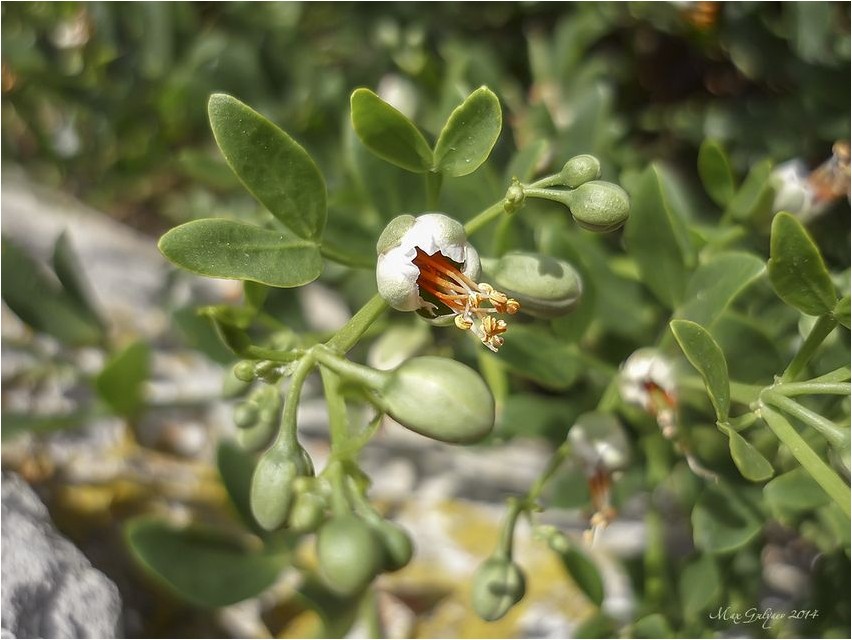
The common leaf is one of the plants of the family called the common leaf; in Latin the name of this plant will be as follows: Zygophyllum fabago L.
As for the name of the common leaf family, in Latin it will be like this: Zygophyllaceae R. Br.
Description of common leaf
Common foliage is a perennial herbaceous plant that is branched and will be endowed with spreading branches. The height of such branches, in turn, will fluctuate between thirty and eighty centimeters. The leaves of this plant are pinnate and opposite, and at the top they will be endowed with a small shoot. There are only two leaves of this plant; they will be unequal, fleshy and oblong-ovate in shape. The stipules of the common leaf are colored green, they are deciduous and their length is four to ten millimeters. The flowers of this plant are whitish in color and have orange petals. There are only five sepals, they will fall off, the corolla of the common leaf is painted white and has an orange center. The length of the petals of this plant will be almost equal to the sepals, which are obovate, and their length is five to eight millimeters. There are only ten stamens of this plant and they are colored orange. The fruit of the common leaf is a pentagonal polyspermous, pendulous and cylindrical capsule, the length of which is about two to four millimeters. The seeds of this plant are yellowish-gray in color and flattened.
Flowering of the common leaf occurs in the first half of the summer season. Under natural conditions, this plant is found in Central Asia, Moldova, Crimea, as well as in the following areas of the European part of Russia: Lower Don, Black Sea and Lower Volga regions. For growth, this plant prefers the banks of reservoirs, hilly sand, salt marshes, clogged loamy soils, wastelands and oases.
Description of the medicinal properties of common leaf
The common leaf is endowed with very valuable healing properties, and it is recommended to use the roots, buds and grass of this plant for medicinal purposes. The term grass includes leaves, stems and flowers. The roots should be harvested in the autumn and spring, while the buds should be harvested in the month of May.
The presence of such valuable medicinal properties is believed to be attributed to the alkaloid harmane in this plant, while the roots contain carbohydrates, harmane alkaloid, triterpene saponins, and tannins. The rhizome of Zygophyllum vulgare contains the alkaloid zygofabagin, while the herb also contains saponins, catechins, triterpenoids, and flavonoids.

Zygophyllum vulgare has valuable anti-inflammatory, wound-healing, antiseptic, and anthelmintic properties. This plant is also widely used in folk medicine. Traditional medicine recommends using Zygophyllum vulgare for rheumatism, various skin conditions, and bladder disorders, as well as as a laxative, antisyphilitic, and anthelmintic agent. A decoction made from the roots of this plant should be used for carbuncles, and an ointment made with mutton fat is used as a wound-healing agent. The leaves are used as a wound-healing, anthelmintic, and detoxifying agent.
Lovage (udalets) &





