Red cabbage
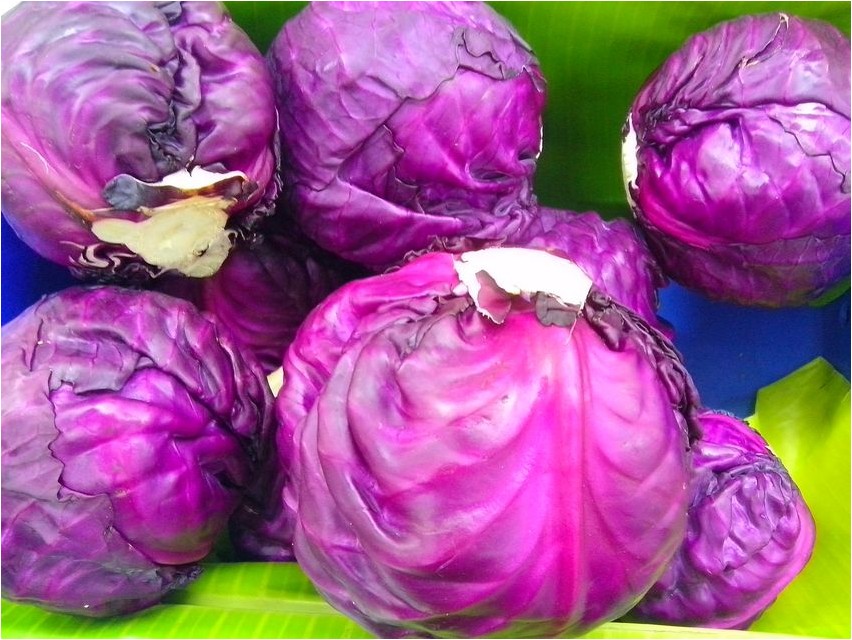
Red cabbage (lat. Brassica oleracea convar. capitata rubra) is a vegetable crop; biennial plant of the Brassica or Cruciferous family.
It is a variety of white cabbage, differing only in its red-violet or bluish-violet color, which is due to the content of the anthocyanin pigment. Red cabbage is native to Western Europe and North Africa.
Characteristics of culture
The botanical characteristics (morphological characteristics, characteristics of growth and development) of red cabbage are practically no different from white cabbage. This is a biennial plant, which in the first year of life forms a thickened stem 15-50 cm high and a head of oval, flat-round, round or cone-shaped. Head weight is from 0. 5 to 3. 2 kg. The stem and internodes are shortened. The root system is powerful and branched.
In the second year of life, the plant forms peduncles and flowers, and then fruits and, accordingly, seeds. The fruit is a pod, 8-12 cm long. The seeds are brownish-brown, round. There are no early ripening varieties of red cabbage. The heads of cabbage are distinguished by good density and transportability, and are well stored in the winter season. Red cabbage is often low yielding. The culture is cold-resistant, young plants can withstand frosts down t o-5C, and adults — up t o-8C. The optimal growing temperature is 15-17C.
Growing conditions

Red cabbage is a light-loving plant; in the shade, the development phases are significantly delayed, the leaves darken, and the heads of cabbage are formed loose and 2-3 weeks later than usual. Red cabbage is demanding on soil moisture, especially at the time of formation of a rosette of leaves and in the initial stage of head formation.
Waterlogged areas, including low-lying areas with stagnant water, are not suitable for growing plants. Soils are preferably fertile, rich in humus with a neutral pH. The last condition is the most important; if possible, it is better to invite a specialist who will analyze the soil for acidity.
The best predecessors of red cabbage are cucumbers, potatoes, onions, peas, tomatoes, legumes, and pumpkin. It is not recommended to grow crops after representatives of the Cruciferous family: rutabaga, turnips, radishes, horseradish, mustard greens and watercress. Cabbage cannot be planted in these areas for at least 2-3 years, otherwise it will often get sick.
Soil preparation and sowing
The area for growing red cabbage is prepared in the fall: deep plowing is carried out with the earth layers turned over, rotted manure, compost or humus are added (1 bucket per 1 sq. m), as well as superphosphate (40 g) and potassium salt (20 g). In the spring, the ridges are loosened and fed with nitrogen fertilizers. Too acidic soils are preliminarily limed or gypsum-treated. To alkalize the soil, you should use fertilizers containing calcium; they will also protect the cabbage from clubroot.
Despite the fact that the crop is characterized by increased cold resistance, it is grown in seedlings, rarely by sowing seeds in the ground. To obtain an early harvest of cabbage, seeds are sown for seedlings in late January — early February, the next sowing is carried out in March-April. Before sowing, it is advisable to treat the seeds with the preparation “Fitosporin” or a solution of potassium permanganate.
Cabbage is sown in seedling boxes filled with a mixture consisting of turf soil, peat and washed river sand. Instead of peat, you can use rotted humus. Immediately after sowing, the soil of the nurseries is spilled generously, covered with polyethylene and taken into a room with an air temperature of 20-25C. With the emergence of seedlings, the temperature is lowered to 10-11C, and after 7-10 days it is raised to 15-17C.
Seedlings are planted two weeks after emergence, and then the first fertilizing is carried out with wood ash and superphosphate. Seedlings of late-ripening varieties do not need to be picked, but only slightly thinned out. Seedlings of early varieties are planted in open ground in early May under a film or in a greenhouse, late varieties — in late May — early June. Before planting, seedlings are hardened off. Seedlings are embedded in the soil up to the cotyledon leaves. Urea, superphosphate and potassium salt are added to the soil that has not been fertilized since the fall. Scheme of planting seedlings 70*35 cm.
Care
Red cabbage is a moisture-loving plant that requires systematic and abundant watering with warm and settled water. The soil should not be over-moistened, nor should it be allowed to dry out. The volume of water is increased during the formation of new leaves and the formation of a head of cabbage.
Red cabbage requires timely loosening of the soil in the stem zone, weeding and hilling. The culture responds positively to fertilizing. During the season, 2-3 feedings are enough: the first is carried out 2-3 weeks after planting the plants in open ground, the second — after 30-40 days, the third — during the period of head formation.
Often the crop is attacked by pests. The most dangerous for cabbage are cruciferous flea beetles, cutworms, cabbage whites and aphids. If they are found on plants, they are treated with insecticides, such as: Aktelik, Intavir, Volaton, Karate, etc.





