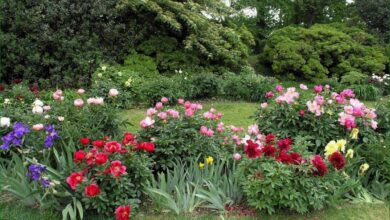
hawthorn

Hawthorn (lat. Crataegus) is a genus of deciduous or semi-evergreen shrubs or small trees of the Rosaceae family.
The culture got its name due to its strong and hard wood and the ability to develop and bear fruit for hundreds of years. Under natural conditions, hawthorn grows in the temperate zone of the Northern Hemisphere, mainly in Eurasia and North America. Hawthorns are found in group or single plantings located along the edges, in clearings, clearings, screes or sparse forests.
Characteristics of culture
Hawthorn is a deciduous or semi-evergreen multi-stemmed shrub or tree 3-12 m high with a dense crown of round, spherical, ovoid or asymmetrical shape. The bark is fissured or unevenly ribbed, gray or brown in color. Some species have bark with peeling small plates. The branches are straight, weeping or curved, quite strong.
Young shoots are densely pubescent, felted or bare, purple-red. Most species are equipped with spines, which are modified shoots. The spines develop from the axillary buds simultaneously with the leaves in the lower part of the shoots. As a rule, the spines are leafless and reach 0. 5-10 cm in length.
The leaves are entire, pinnately incised, lobed or dissected, serrate or toothed, glabrous or pubescent, petiolate or sessile, ovate, obovate, round, rhombic or elliptical in shape. The leaves are arranged spirally, often twisted at the tips of short shoots. Long shoots have larger leaves than short shoots. Stipules fall early. In autumn, the leaves of most species turn orange, gold, brown and purple.
The flowers are white or red, collected in complex umbellate and corymbose inflorescences. There are species with single flowers. Sepals are tomentose, densely pubescent or bare, falling off or remaining with the fruit. The fruit is a small apple, 0. 5-4 cm in diameter. The fruits can be spherical, pear-shaped or elongated. The fruits contain from 1 to 5 large triangular seeds with a hard, stony shell. From one tree you can get up to 50 kg.

Growing conditions
The crop does not have any special requirements for growing conditions and site location. Hawthorn is a light-loving crop, but partial shade will not be an obstacle to the development of shrubs and trees. Full shade is detrimental to crops. Since hawthorn has a well-developed root system, it takes root even on steep slopes. Drained, moderately moist, fertile and heavy soils are optimal for the crop. Hawthorn accepts limed soils.
Reproduction and planting
Hawthorn is propagated by seeds, layering and root suckers, and cultivated species by grafting. The seed method is quite labor-intensive. Seeds require long-term stratification (up to 7-8 months). Winter sowing is not prohibited; in the first year, about 20-30% germinate, and the next year another 50-60%. The germination percentage can be increased precisely through seed stratification. Hawthorn takes cuttings very poorly; propagation by layering and suckers is most acceptable for the crop. Cultivated forms are propagated by grafting; common hawthorn (lat. Crataegus laevigata) and single-pistillate hawthorn (lat. Crataegus monogyna) are used as rootstocks.
Most gardeners grow hawthorn by planting three, four or five year old seedlings. They are planted in early spring or autumn, but a couple of months before the onset of stable frosts. Before planting, the roots of the seedling are dipped in a clay mash with the addition of potassium permanganate and a small amount of manure. The depth of the planting hole should be about 60-70 cm, and the width — 50-60 cm. When planting, the root collar is not buried. The soil in the tree trunk zone is compacted tightly, watered abundantly and mulched with peat.
Care
Caring for hawthorn consists of systematic watering, weeding, fertilizing and sanitary pruning. Water abundantly, at the roots. Young plants need high humidity; the soil in the tree trunk area should not be allowed to dry out. The soil must be saturated to a depth of at least 50 cm. The crop is often attacked by pests and diseases. The most dangerous for plants are hawthorn, lacewing, apple worm, scale insect, apple aphid, and ringed silkworm. Among the diseases, powdery mildew should be noted. To combat pests and diseases, herbal infusions, as well as approved insecticides, should be used.