Euphorbia waldsten
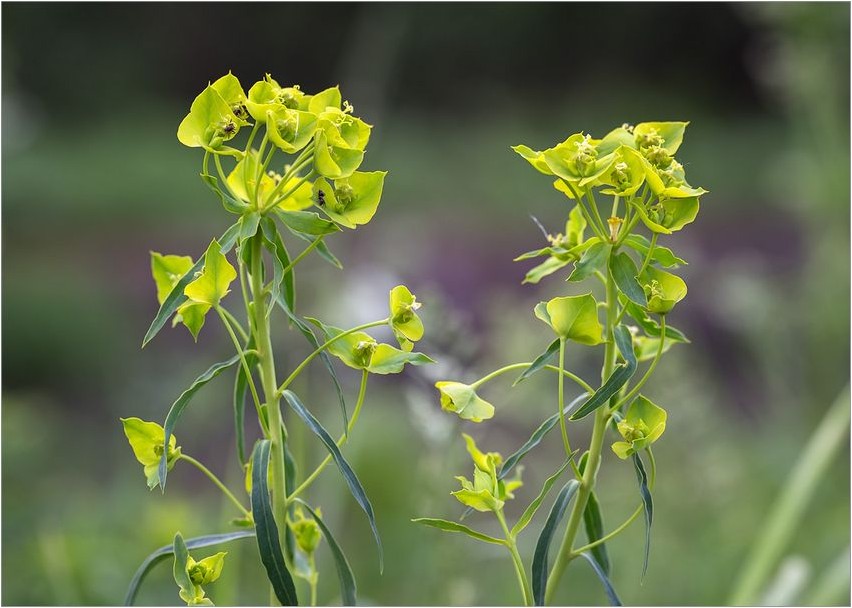
Euphorbia waldstenii is one of the plants of the family called Euphorbiaceae, in Latin the name of this plant will be as follows: Euphorbia waldstenii (Sojac.) Czer. (E. virgata Waldst. et Kit.).
As for the name of the Waldsten milkweed family itself, in Latin it will be: Euphorbiaceae Juss.
Description of Euphorbia Waldsten
Euphorbia Waldsten is a perennial herbaceous plant that is glabrous and bluish, and its height varies between forty and eighty centimeters. The root of such a plant can be either oblique or vertical; it will be multi-headed and branched. The stems are present in small numbers and will be branched, erect and twig-like. At the top, such stems of Euphorbia Waldsten are endowed with approximately five to twenty axillary pedicels, the length of which can reach up to five centimeters. The lower leaves of this plant are cup-shaped, they are stemlike, can be either sessile or barely appressed, and also linear. The length of such leaves of Euphorbia Waldsten is about two to nine centimeters, and the width is two to ten millimeters. There can be from five to fifteen apical peduncles, and their length is about seven to forty-five millimeters; the involucre leaves and upper stem leaves of this plant are sessile and they are colored green. The involucre leaves of this plant will be yellowish-green, the cup is bell-shaped, its length is about two to two and a half millimeters, and its diameter is about one and a half to two millimeters. The three-nut of Euphorbia Waldsten will be obtusely ovoid, its length is three to four millimeters, and its width is four to four and a half millimeters, while the seed of this plant will be broadly ovoid and colored in brownish-violet tones.
Euphorbia Waldsten blooms from June to August. Under natural conditions, this plant is found in Central Asia, Belarus, Ukraine, Western Siberia, the European part of Russia, with the exception of only the Karelo-Murmansk region, as well as in the Angara-Sayan region of Eastern Siberia. For growth, this plant prefers garbage areas, arable lands, fallow lands, pastures, fields, places near roads, mixed-grass steppes, steppe slopes of hills and ravines, forest edges, water meadows, forest lawns, sandy and carbonate soil. It is noteworthy that this plant is an insecticide.
Description of the medicinal properties of Euphorbia waldstenii
Euphorbia waldstenii possesses highly valuable medicinal properties, and its roots, sap, and herb are recommended for medicinal use. The herb includes the leaves, flowers, and stems.
These valuable medicinal properties are explained by the alkaloids it contains, while the milky sap of the stems, roots, and leaves contains resins and malic acid. Euphorbia waldstenii roots contain resins and rubber. The herb contains the flavonoids hyperin and quercetin, while the stems contain resins and rubber, and the seeds contain fatty oil.

The milky sap of Euphorbia waldstenii is recommended for external use for various skin conditions, as well as for the treatment of cancer. A decoction made from the roots of this plant is recommended for use as an emetic, laxative, anthelmintic, diuretic, analgesic, antipyretic, and anticancer agent. It is worth noting that the leaves and young stems are used externally for leishmaniasis and dermatomycosis, calluses and warts, and are also used as a cosmetic.





