Cotoneaster entire-margined
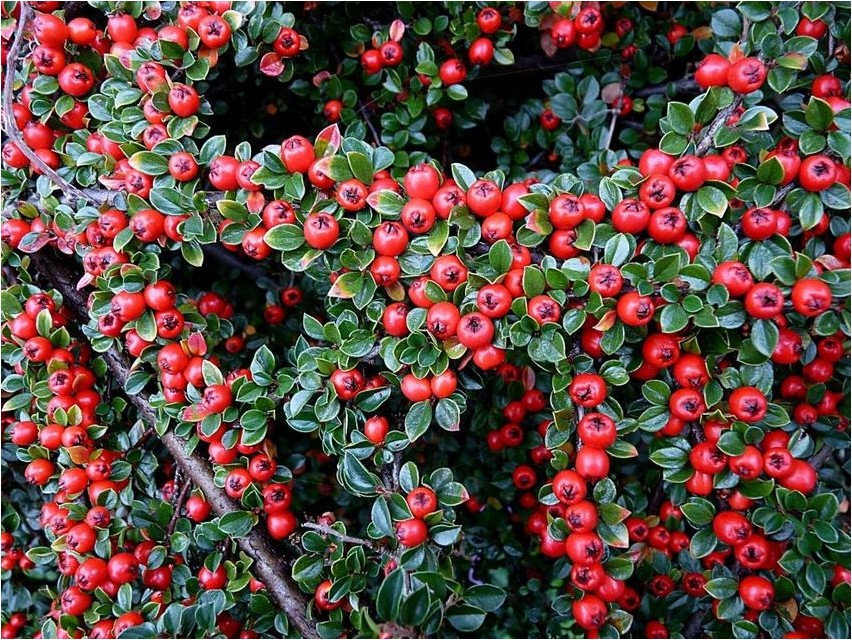
Cotoneaster entire-margined is a member of the Rosaceae family, and its Latin name is Cotoneaster integerrima Medik.
The Latin name of the Rosaceae family itself is Rosaceae Juss.
Description of Cotoneaster entire-margined
Cotoneaster entire-margined is an upright shrub reaching three meters in height. This plant has a broad, spreading crown, with leaves approximately one to four centimeters long and no more than two and a half centimeters wide. The leaves are broadly or oblong-ovate in shape. Flowers are borne in clusters of one to three, most often two in a drooping raceme. Mature fruits are purple-red in color, about eight to eleven millimeters long, and contain three to four seeds. The entire-margined cotoneaster blooms in July, and fruiting begins in September. In the wild, this plant is found in Western Siberia, the Caucasus, the Baltics, European Russia, and the Carpathian Mountains in Ukraine. The entire-margined cotoneaster prefers rocky slopes, cliffs, scree slopes, and river valleys, from the lower to upper mountain belts.
Description of the medicinal properties of the entire-margined cotoneaster
The entire-margined cotoneaster has valuable medicinal properties, and it is recommended to use the fruits, leaves, and branches of this plant for medicinal purposes. These valuable medicinal properties are due to the cyanogenic compound prunasin found in the branches, while the leaves contain phenolic acid and its derivatives: flavonoids and chlorogenic acid. The fruits of this plant contain vitamin C.
In Tibetan medicine, this plant is quite widespread, and a decoction of the wood is often prepared from it. This remedy is recommended for neurasthenia, neuritis, and gastroenteritis. In folk medicine, a decoction made from the branches of the cotoneaster is widely used, as is a decoction of the leaves. These rather effective remedies are used for jaundice and ascites.
As for the fruits of this plant, they are effective when taken orally for dysentery and diarrhea. It is noteworthy that the fruits of the entire cotoneaster will be edible in their raw form.

For cystitis and diarrhea, it is recommended to use the following very effective remedy based on cotoneaster: to prepare such a remedy, you will need to take twelve grams of crushed dry branches per glass of water. The resulting mixture should be boiled for six to seven minutes over very low heat, after which the mixture is left to infuse for two hours, then this mixture based on cotoneaster should be filtered very carefully. Take the resulting product based on this plant, one third of a glass three times a day. It is important to remember that in order to ensure the greatest effectiveness when taking such a remedy based on this plant, you should strictly follow not only all the rules for preparing such a remedy, but also all the rules of administration.
For jade, it is recommended to use the following remedy based on this plant: for preparation you will need to take three tablespoons of dry crushed leaves to two glasses of water. The resulting mixture should be boiled for six to seven minutes, and then it is infused for two hours and carefully filtered. Take this remedy based on whole cotoneaster, one-fourth of a glass three times a day before meals.
Cotoneaster horizontal in autumn





