Angelica Daurica
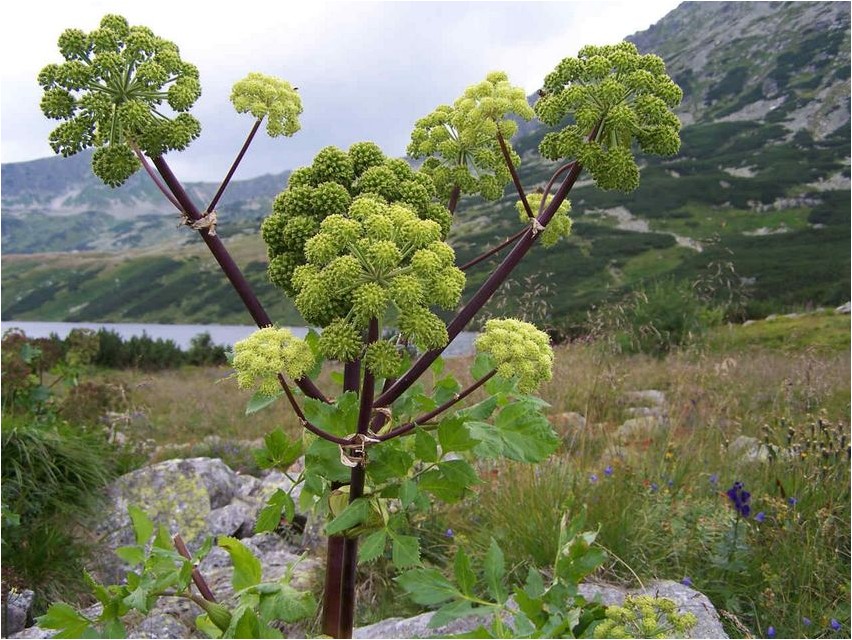
Angelica Daurica is one of the plants of the family called Umbellaceae; in Latin the name of this plant will be as follows: Angelica dahurica.
As for the name of the angelica family itself, in Latin it will be: Apiaceae Lindl.
Description of angelica dahurian
Angelica Daurica is a perennial herbaceous plant endowed with a root two and a half centimeters thick. The stem of this plant is round and soft, most often it is colored purple. Inside, such a stem will be hollow, and it is also thin-walled and finely grooved; under the inflorescence, most often the stem is short pubescent in the first internode. The height of the stem of this plant will fluctuate between eighty and one hundred and fifty centimeters. The lower leaves are on long petioles; at the base they expand into a swollen sheath. The leaves can be either double- or triple-pinnate, their length is thirty to fifty centimeters, and their width is about twenty-five to forty centimeters. The upper leaves are sessile and smooth, they are located on a large and highly swollen sheath. The inflorescences are umbrellas, they are endowed with twenty to forty pubescent rays. The fruits of angelica dahurian are equipped with thick dorsal and marginal ribs.
This plant blooms in July. Under natural conditions, angelica daurica can be found in the Primorye and Amur regions of the Far East, as well as in the Daursky and Leno-Kolyma regions of Eastern Siberia. As for the general distribution, this plant is found on the Korean Peninsula, Japan, China and Manchuria. For growth, angelica daurica prefers places along the banks of lakes, rivers and streams, as well as thickets of coastal bushes, meadows and forest edges.
Description of the medicinal properties of angelica dahurian
Angelica Daurica is endowed with very valuable healing properties, and it is recommended to use the roots of this plant for medicinal purposes. Roots should be harvested either in autumn or spring.
The plant is endowed with wound-healing, analgesic, anti-inflammatory, hemostatic, antispasmodic, diaphoretic, anthelmintic, and diuretic effects. In addition, the plant also has antitumor activity.

As for traditional medicine, a decoction and infusion of the roots of this plant is used as a hemostatic agent for hematuria, hemorrhoids and other bleeding, as well as for headaches and toothaches, neuralgia, skin diseases and some female diseases, including cessation of menstruation.
When you have a cold, it is recommended to use the following fairly effective remedy based on Angelica Daurica: to prepare it you will need to take six grams of the roots of this plant per glass of boiling water. The resulting mixture should be boiled in a water bath for twenty to thirty minutes, after which the mixture is infused for an hour and filtered, and boiled water is added up to the original volume. Take this remedy one third of a glass three to four times a day. To achieve greater efficiency, it is recommended to follow all the rules for preparing such a product.
For furunculosis, the following remedy should be used: to prepare it, take eight grams of crushed roots of this plant in half a liter of water, then these roots are infused in a sealed container for two hours and filtered. Take this remedy one third of a glass three times a day.
If you have a cold, you can also steam twenty grams of angelica daurica roots, and then this mixture is divided into two parts and taken twice.





