Arctic Spoon Grass
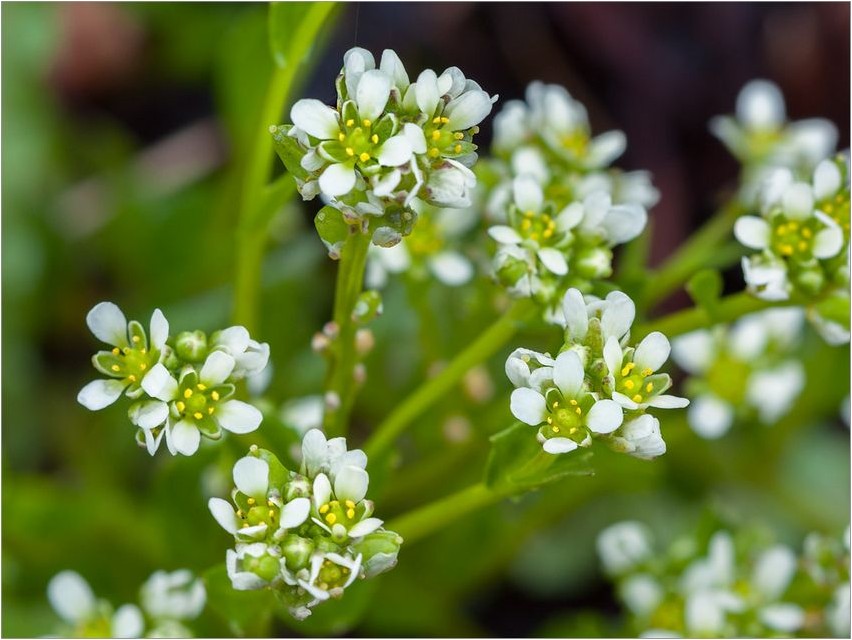
Arctic Spoon Grass is a member of the Brassicaceae or Cruciferae family. Its Latin name is Cochlearia arctica Schlecht. (Cochlearia fenestrata).
The family name of Arctic Spoon Grass itself is Brassicaceae Burnett. (Cruciferae Juss.).
Description of Arctic Spoon Grass
Arctic Spoon Grass is also known by numerous common names, including horseradish, varukha, sea lettuce, and scurvy grass. Arctic Spoon Grass is a biennial succulent herbaceous plant, one of a relatively limited number of plants that have adapted to the very harsh conditions of the tundra. It is noteworthy that in the first year, only a rosette of basal leaves develops. The leaves of this plant are simple, borne on fairly long petioles, and have a single blade. They are either oval or broadly triangular-ovate. In the second year, a flowering stem will emerge from the center of the rosette, reaching a height of between fifteen and forty centimeters. The upper portion of this stem will be branched. The stem leaves of the arctic spoonwort are sessile, sometimes with sparse, blunt teeth along the margins. The flowers of this plant are quite small, white in color, and feature a corolla consisting of four petals, each three and a half to four millimeters long. This plant has only six stamens, and the pistil bears a superior ovary, consisting of two fused carpels. The flowers of the arctic spoonwort are collected at the top of the stem and branches in racemes. The fruits of this plant are round-ovoid pods that sit on fairly long stalks.
The arctic spoonwort blooms from June to July. In the wild, this plant is found throughout the polar-arctic zone along the coast of the Ice Ocean, as well as in European Russia, along the Okhotsk coast, along the shores of the Baltic Sea, in Siberia as far as Chukotka, and in Kamchatka. This plant prefers elevated areas, tundra, sandy shores, and clay hills. It should be noted that the arctic spoonwort is sometimes cultivated as a vegetable in northern Russia.
Description of the medicinal properties of Arctic spoonwort
Arctic spoonwort is endowed with very valuable healing properties, and it is recommended to use the basal leaves and grass of this plant for medicinal purposes. The term grass includes flowers, stems and leaves. It is recommended to harvest such raw materials from May to July.
It is noteworthy that this plant cannot be called a rare plant, and for this reason, when collecting arctic spoonwort, it is recommended to take the usual precautions as when collecting any other plants.

Arctic spoonwort is endowed with very valuable wound-healing, anti-inflammatory, anti-scorbutic, diaphoretic, anti-inflammatory, carminative and anthelmintic effects.
Infusion of the herb and fresh juice of this plant are recommended for use for scabies, scurvy, paralysis, lichen, as well as for various skin inflammations that will be accompanied by itching. In addition, such drugs are used for gout, cystitis, rheumatism, female diseases, various diseases of the gastrointestinal tract and respiratory tract diseases.





