Clematis vine-leaved
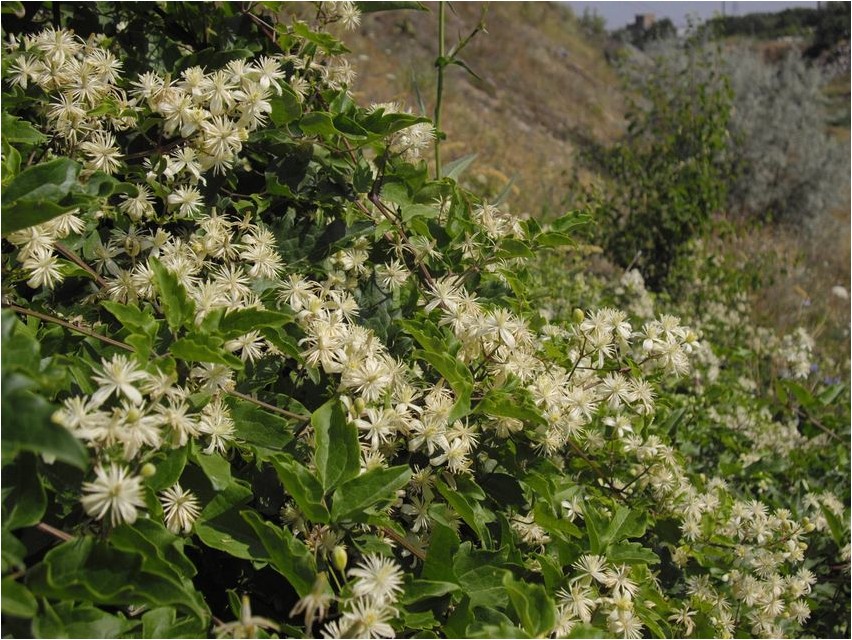
Clematis vitalba L. is one of the plants of the family called Ranunculaceae; in Latin the name of this plant will be as follows: Clematis vitalba L.
As for the name of the clematis vine-leaved family itself, in Latin it will be: Ranunculaceae Juss.
Description of Clematis vinefolia
Clematis vinifolia is a woody vine with a ribbed stem. The leaves of this plant are opposite and petiolate, they will be trifoliate and such leaves are endowed with broadly lanceolate leaflets. The flowers of Clematis vinifolia are painted in delicate white tones; they are quite small in size with a coronal four-petalled perianth, which in turn will be seated with white fibers. This plant has many stamens and pistils, and the flowers are collected in corymbose inflorescences, while the fruit is a polysperme.
Clematis vine-leaved flowering occurs during the period from June to July. It should be noted that this plant will be endowed with a rather pungent odor and burning taste, which will cause salivation and lacrimation. Clematis vine is a poisonous plant, for this reason it is recommended to use extreme caution when handling this plant.
Description of the medicinal properties of Clematis vinifolia
Clematis vine-leaved is endowed with very valuable healing properties, and it is recommended to use the flowers and grass of this plant for medicinal purposes. The presence of such valuable healing properties should be explained by the content of clematitol and anemonol in the leaves and flowers of this plant, which will cause irritation and redness of the skin. In addition, such elements of this plant contain waxy substances, saponin, glycoside stigmasterol, sitosterol, clemantitin and leontin.
As for traditional medicine, the flowers and leaves of Clematis vine-leaved are quite widespread here. Such healing agents are used for stomach ulcers, headaches, scabies, bone tumors and sexually transmitted diseases. In addition, such medicinal products based on this plant are used as a strong laxative, diaphoretic and diuretic. The powder produced from the leaves of this plant is used for scabies, lichen, eczema and numerous other skin diseases. In addition, clematis vine is also used in homeopathy for malaria, cystitis and conjunctivitis.

It should be noted that, according to the available literature data, many authors are convinced that when the elements of this plant are dried, their toxicity will disappear. However, it is still recommended to exercise strict caution and under no circumstances allow an overdose of drugs produced on the basis of clematis vinosa.
It should be noted that for the reason that both the chemical composition of this plant and the degree of its toxicity and those phenomena in which a loss of toxicity is possible have not yet been fully studied, the number of uses for medicinal purposes of clematis vine is still quite limited. However, many researchers emphasize that this plant is endowed with great medicinal potential and for this reason, research on clematis grapefruit for use in medicine is still ongoing. Actually, it is for this reason that it is possible in the near future to expect the emergence of new methods of using elements of the clematis vine plant for medicinal purposes.





