Boxwood
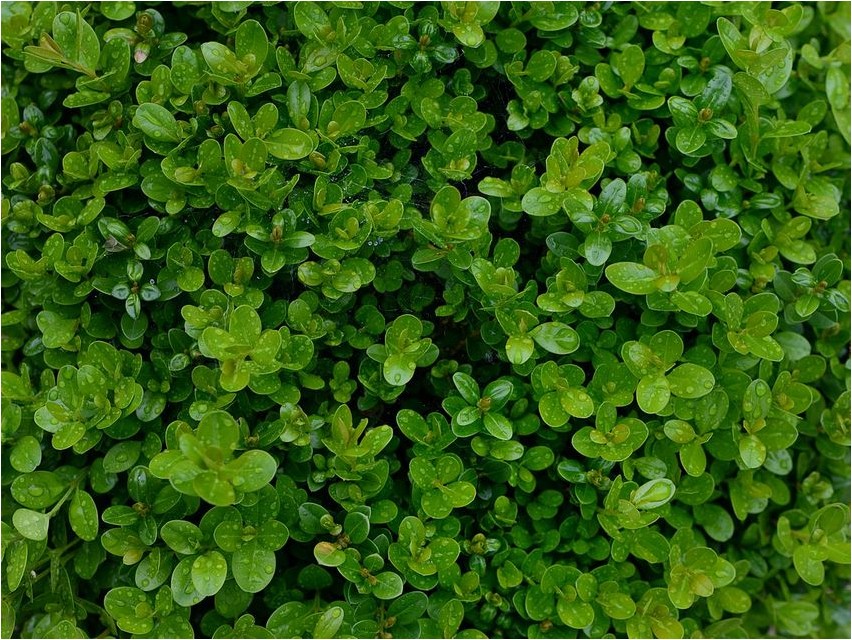
Boxwood (lat. Buxus) is an evergreen shrub or tree of the Boxwood family. Under natural conditions, boxwood grows in the Mediterranean, Eastern India and Southeast Asia. Currently there are about 30 species.
Characteristics of culture
Boxwood is a slow-growing shrub or tree 2-15 m high. The shoots are straight, tetrahedral, green, and densely leafy. The leaves are opposite, entire, leathery with a shine, round or elliptical in shape, dark green in color. The flowers are small, yellowish-green, collected in axillary or capitate inflorescences, and have a pleasant aroma. The fruit is a three-locular capsule, spherical in shape with valves. The seeds are black and shiny. All parts of the plant are poisonous, especially the leaves.
Growing conditions
Boxwood is a heat-loving plant that thrives in both sunny and shaded areas. The crop is not demanding on soil conditions, but develops best on loose, well-drained, fertile and moderately moist soils with a high lime content. Boxwood has a negative attitude towards saline and heavy soils. The level of winter hardiness of plants is not predictable; much depends on the location of the shrubs on the site. Boxwoods grown in dry and poor soils tend to tolerate cold winters better than those grown in compacted and heavy ones.
Application

Boxwood is a highly ornamental plant that looks great in both single and group plantings. The culture is often used to form hedges and borders. Due to the fact that boxwoods have the ability to maintain a certain shape for a long time, in the southern regions the plants are used in topiary art.
Reproduction and planting
Boxwoods are propagated by seeds, summer and autumn cuttings. The second method is the most common and effective. As a rule, from 80 to 100% of cuttings take root. Summer cuttings are cut in June — July, and autumn cuttings — in late August — early September. The length of the cuttings should be about 5-10 cm. The top two leaves on the cuttings are left, the rest are removed.
The cuttings are planted in a substrate consisting of garden soil and peat (1:1) and covered with plastic film. Watering is carried out daily. After about 3-4 weeks, the cuttings take root. By autumn, neat bushes form and are transplanted to a permanent location. Cuttings that are not completely rooted are planted in containers and kept indoors until spring.
Care
Boxwood is a rather capricious culture. The most difficult period for cultivating boxwoods is the long and protracted winter with alternating frosts and thaws, as well as sudden changes in cloudy and sunny days. Snowless winters are also dangerous for plants. In the fall, before the onset of stable frosts, abundant moisture-recharging watering is carried out, which allows the shrubs to be saturated for the winter months. After watering, the tree trunk area is mulched with peat or rotted pine needles. It is not recommended to use fallen leaves, since in wet winters they cause the boxwoods to become overheated and the development of various fungal and viral diseases.
Low spherical shapes of boxwoods are covered with wooden or plastic boxes with ventilation holes. Standard trees are protected from breakage and the action of wet snow with the help of supports and protective cover in the form of spruce branches or non-woven material. Hedges and borders made of boxwood are covered with burlap in two or three layers, carefully securing the ends. With the onset of spring, the shelters are removed, and the snow remaining near the tree trunks is loosened and cleared to the side. This procedure will help quickly warm the soil and supply moisture to the roots and leaves.
Sanitary pruning and haircutting are carried out in April, in the northern regions — in early May. Since boxwoods grow very slowly, it is necessary to limit yourself to light crown adjustments and pruning of new growth. Shoots are cut down to old wood only if the plants have completely lost their shape. The crop also needs regular feeding. At least three feedings are carried out per season. Organic fertilizers are applied only in the fall; bird droppings or slurry are ideal for this purpose.