Origanum
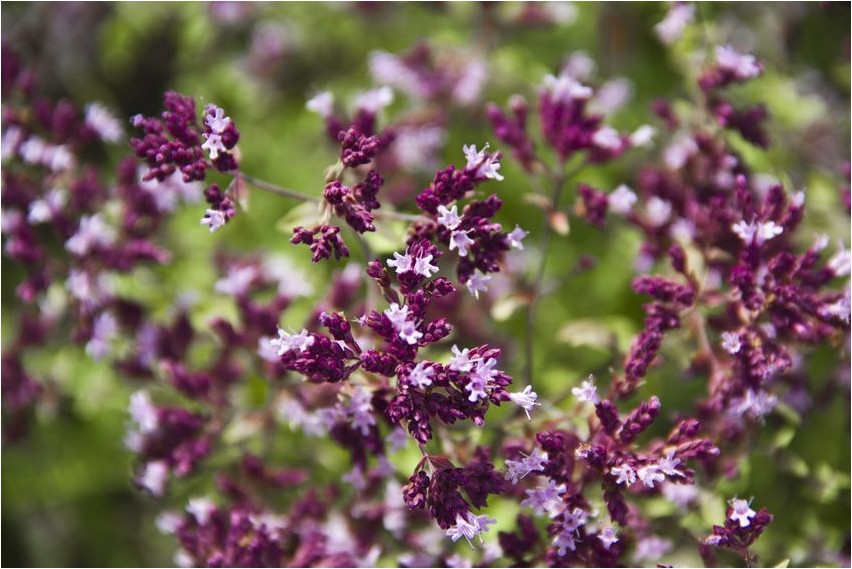
Origanum (lat. Origanum) is a winter-hardy, drought-resistant perennial that is a member of the Lamiaceae family. Its second name is oregano.
Description
Origanum can be either a perennial or a semi-woody plant, the height of which can vary from ten centimeters to one meter. The branched rhizomes of origanum are most often creeping, and its soft pubescent tetrahedral stems are usually erect and branched in the upper part.
The petiolate opposite leaves of the origanum are characterized by an oblong-ovate shape and are slightly pointed at the tips. The length of these leaves ranges from one to four centimeters, while they are dark on top and colored grayish-greenish below.
Numerous small flowers of origanum form beautiful corymbose-paniculate inflorescences. The two-lipped corollas consist of five petals – when fused, these petals form both corolla tubes and two-lipped limbs. In this case, the upper lip always grows together from only two petals, and to form the lower lip, three petals are used.
In total, the genus Origanum has about eight species.
Where does it grow
Origanum can most often be found in Europe, North America and Asia. By the way, in Russia this plant grows almost everywhere, with the exception of the Far North. Especially often, origanum can be seen growing on hillsides, in open, dry grassy areas, as well as among bushes, on the edges and in clearings.

Usage
Origanum vulgare is most actively used for decorative purposes. Growing quickly, this amazing plant forms quite dense, spectacular clumps. Origanum can be safely planted together with various steppe plants; in addition, liatris, gypsophila and mint will be excellent partners for it. Origanum is especially often cultivated in France and the USA.
Origanum is also widely used for aromatherapy purposes. In order to be in a good mood even on cloudy days, it is enough to plant several origanum bushes in your garden and, each time you pass by, lightly touch them with your hands.
And origanum tea boasts the ability to normalize digestion, as well as relieve headaches, fatigue and stress.
Growing and care
Origanum grows best in sunny areas with dry, permeable soil. The soil must be sufficiently loose and thoroughly cleared of weeds! This plant is generally undemanding, but will do poorly in acidic or heavy clay soils.
To maintain loose soil, it is necessary to periodically loosen the soil within the rows and cultivate the spaces between the rows. Typically, the first inter-row cultivation is carried out at the beginning of the growing season in early spring, with subsequent cultivations carried out as needed. After mowing, this cultivation is essential! And just like the first spring cultivation, it is necessary to apply high-quality mineral fertilizers.
Origanum should be watered only if moisture is insufficient. Post-harvest irrigation is considered the most effective—it will promote more uniform and harmonious growth of the above-ground parts of the plant. Organum propagates primarily by dividing the clumps in the spring. It can also be propagated by seeds, which are sown in cold frames or beds in early spring or fall.
Oregano basic info Marjoram Origanum





