Dipelta
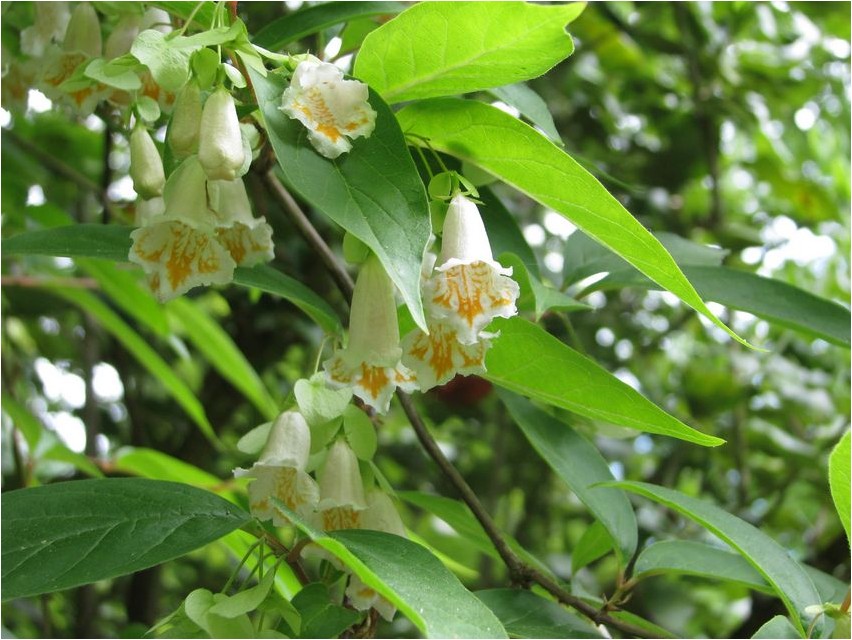
Dipelta (lat. Dipelta) is a genus of beautifully flowering shrubs of the Honeysuckle family (Caprifoliaceae). The genus includes four species. The homeland of dipelta is China. In terms of external characteristics, dipelta is similar to weigela.
Characteristics of culture
Dipelta is an ornamental shrub up to 2 m high. The shoots are numerous and flexible. The leaves are serrated or entire, narrow, pointed, opposite, short-petioled, and have no stipules. The flowers are large, fragrant, white or pink, solitary or collected in few-flowered racemes, equipped with pronounced bracts at the base. Sepals are elongated, lanceolate or linear. The fruit is a capsule.
The most common species among the representatives of the genus is Dipelta floribunda. Its flowers are pink in color with a yellowish throat, solitary or collected in groups. The species blooms very profusely, which is why it is valued by modern gardeners. Most often it is grown on personal plots, less often on alleys and parks (mainly in the southern regions).
Subtleties of cultivation and reproduction
Dipelta prefers well-moistened, fertile, clay and calcareous soils. Does not tolerate compaction, salinity and waterlogging. Negatively relates to highly acidic and waterlogged soils. The culture is photophilous, although it can develop normally in partial shade. Dense shadow is undesirable.
Reproduction of dipelta is difficult. You can try to propagate the crop by seeds and lignified cuttings. The seed method is very labor-intensive and time-consuming, and does not allow you to fully preserve the properties and characteristics of the mother plant.
Reproduction by lignified cuttings does not give 100% results. Cuttings are taken from the middle part of healthy and strong shoots. The optimal cutting length is 7-12 cm. The cuttings are planted in an inclined position in a substrate composed of river sand and peat. It is better to plant in seedling containers or in a greenhouse. The substrate is regularly moistened. Dipelta, propagated by cuttings, is planted in open ground after 1. 5-2 years.

Care
The general condition of the shrubs and the abundance of their flowering depend on proper care. Fertilizing plays an important role in the development of dipelta. Fertilizers are applied twice per season: the first time in early spring, the second time before flowering. You can use both complex mineral and organic fertilizers for fertilizing.
Sanitary and formative pruning is performed in the spring (before the sap begins to flow). For the first ten years, only broken and diseased branches are removed from the shrubs. Subsequently, all shoots are pruned annually, leaving at least three buds on each. Water 2-3 times per season; during prolonged droughts, the frequency and volume of water used are doubled.
Dipelta is often attacked by pests and diseases, so preventative treatments are essential. The greatest threat to this plant is the honeysuckle aphid (as with other members of the Honeysuckle family). Aphids cause yellowing, curling, and leaf drop, as well as stunted shoot growth, preventing shoots from maturing and causing severe winter frosts. Regular spraying with yarrow decoction or hot pepper infusion is a preventative measure.