Magnolia
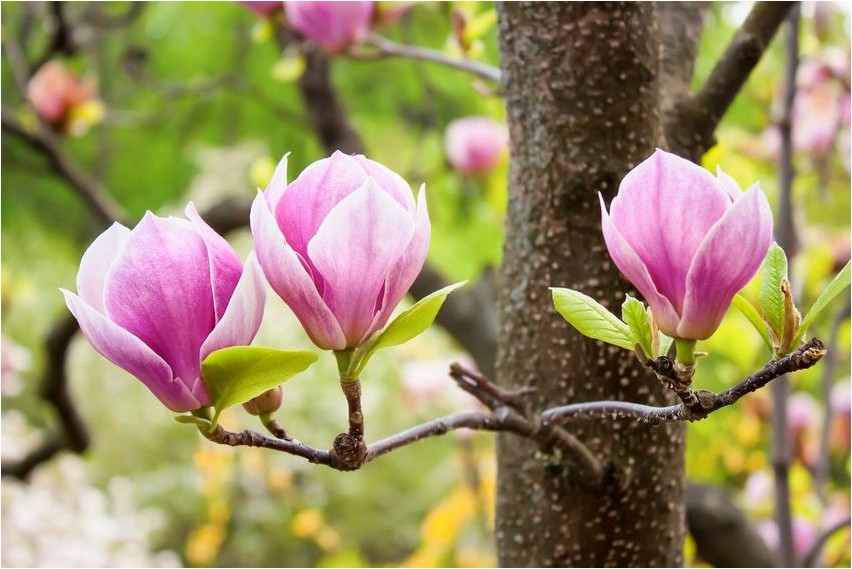
Magnolia (lat. Magnolia) is a beautiful flowering crop belonging to the Magnoliaceae family. In nature, the plant is found in the USA and some Asian countries. In Russia it grows on Sakhalin. Currently there are more than 200 species.
Description
Magnolia is represented by deciduous or semi-evergreen shrubs, less often trees, the trunks and branches of which are covered with brownish or gray bark, smooth or rough to the touch. The foliage of the crop in question is whole, green, leathery, obovate, equipped with stipules.
The flowers are fragrant, large, solitary, depending on the type and variety, they can be snow-white, creamy or purple in color, have a six-petalled perianth and a three-leaf calyx. The fruits are in the form of cone-shaped leaflets containing black seeds.
Subtleties of cultivation
Magnolia is demanding both in terms of location and soil. The plant prefers sunny areas with protection from winds. The soil for growing magnolias should be light, rich in humus, loose, moist with a neutral or slightly acidic pH. The culture does not tolerate coexistence with heavy, saline, damp and acidic soils.
Features of reproduction
Magnolias are propagated by seed, cuttings and layering. Seeds are most often propagated. Sow seeds in the ground in autumn. In winter, crops are mulched with peat or a thick layer of fallen leaves. Non-winter-hardy varieties are sown in containers and grown at home. Initially, the plants develop very slowly; in the second year, the seedlings are picked and grown in boxes. In the third year, the plants are planted in the ground.
Propagation by cuttings of magnolias is somewhat difficult, since they take root only in a certain microclimate. regime. To propagate the crop by layering, it is necessary to have a low-growing shoot of the bush. It is pinned to the soil with staples, having previously made an incision in the form of a ring. Rooted cuttings are cut from the mother plant and transplanted to the area where cultivation is planned.

Care
Magnolia is a moisture-loving plant that requires systematic moistening. Plants respond well to fertilizing with mineral fertilizers and mulching with peat and compost. It should be remembered that the lack and excess of fertilizers negatively affects development.
With the onset of cold weather, it is recommended to wrap young magnolias with lutrasil for insulation. Aged plants do not require shelter. Sanitary and formative pruning is important for magnolias; the first is aimed at cutting out old and dry shoots.
Magnolias are prone to pests and diseases. One of the harmful crop pests is the spider mite; it can be controlled with the help of insecticides. Another dangerous enemy is mice. Mice can damage the root collar.
Usage
Magnolias are unusual and beautiful. They are highly decorative and can decorate any garden plot. Plants are actively used in ornamental gardening. They look great either alone or in groups. Magnolias fit perfectly into compositions with other flowering shrubs. The foliage of the plants has found its use in medicine; they are used to create various medications for heart disease and hypertension.
https://www. youtube. com/watch? v=if5Q1bYGxjc