Goat grass
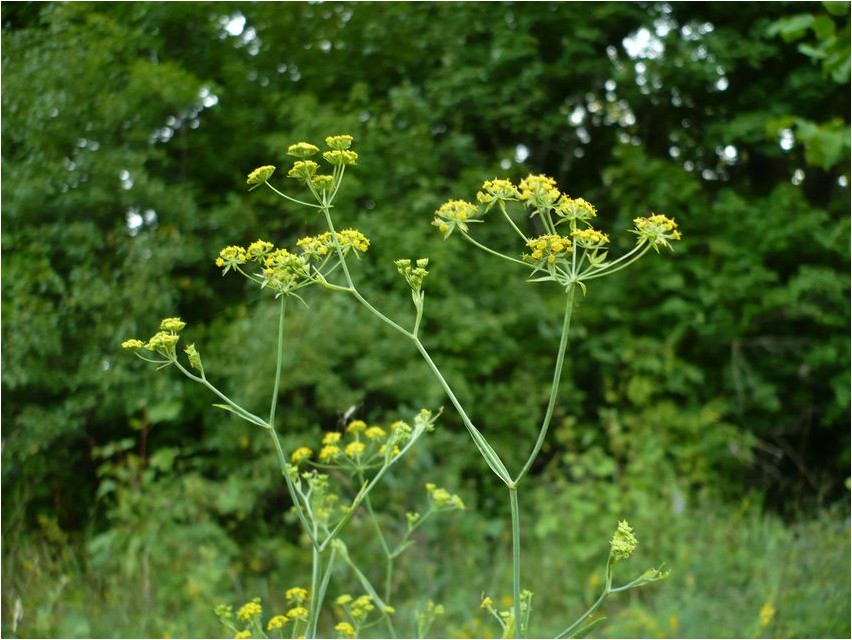
Bupleurum scorzonerifolium Willd.
As for the name of the goatweed family itself, in Latin it will be like this: Apiaceae Lindl.
Description of the goatweed
Goat grass is a perennial herbaceous plant, the height of which can vary between fifteen and seventy centimeters. The plant can be endowed with either single or very few stems, which will be branched in their upper part. All leaves of the gooseberry are entire and entire-margined, they are endowed with arcuate venation. Moreover, the basal and lower stem leaves of this plant can be from linear to lanceolate or oblong-lanceolate; such leaves are endowed with long petioles, and upward along the stem they will decrease, turning into sessile.
The inflorescences look like numerous umbrellas, endowed with thin and slightly arched curved rays; they can be either with or without a wrapper: the wrapper will consist of one to five unequal leaves. The involucre leaves are five or six in number; they can be oval or linear-lanceolate in shape, they are pointed, and can be either pressed to the rays of the umbrella or almost equal to them. It is noteworthy that the calyx teeth are invisible. The petals will be yellow in color, their tops are very strongly curved inward. The fruits are slightly compressed from the sides, their shape can be either ovoid or oblong, their length will be about two to three millimeters.
This plant has become widespread in Altai in Western Siberia, as well as in the Far East in the Amur region; in addition, the goat-leaved grass can also be found in the following areas of Eastern Siberia: in the Daursky region and Angaro Sayansky. For growth, this plant prefers dry oak and pine-oak forests, as well as rocks, rocky steppe slopes and steppe meadows.
Description of the medicinal properties of goatweed
For medicinal purposes, it is recommended to use the roots, fruits, and herbs of this plant. It should be noted that this plant is one of those components that are most often found in the most complex recipes in traditional medicine in Southeast Asia. Actually, this plant is used as a general strengthening and tonic.

In Chinese and Korean medicine, a decoction and infusion of Bupleurum scotifolia roots are used as antipyretic, anti-inflammatory, diaphoretic, and diuretic agents. Furthermore, this remedy is recommended for hepatitis, infectious diseases, flatulence, cholecystitis, dizziness, headaches, and impotence. Furthermore, this plant is used externally for itchy and pustular dermatoses, as well as eye diseases. It should be noted that this remedy is also contraindicated for cholelithiasis.
Preparations made from Bupleurum scotifolia roots have an antipyretic effect, and the extract itself has antitumor properties. A decoction and infusion of this plant’s roots are used in Tibetan medicine for various liver, heart, and kidney diseases as an antipyretic and choleretic agent. As for the herb powder, it can be used as a wound-healing remedy for felons and purulent wounds. In fact, clinical trials have shown that a decoction of Bupleurum saccharifolia herb has a choleretic effect, as well as the ability to enhance the secretory function of the stomach and pancreas.