St. John’s wort
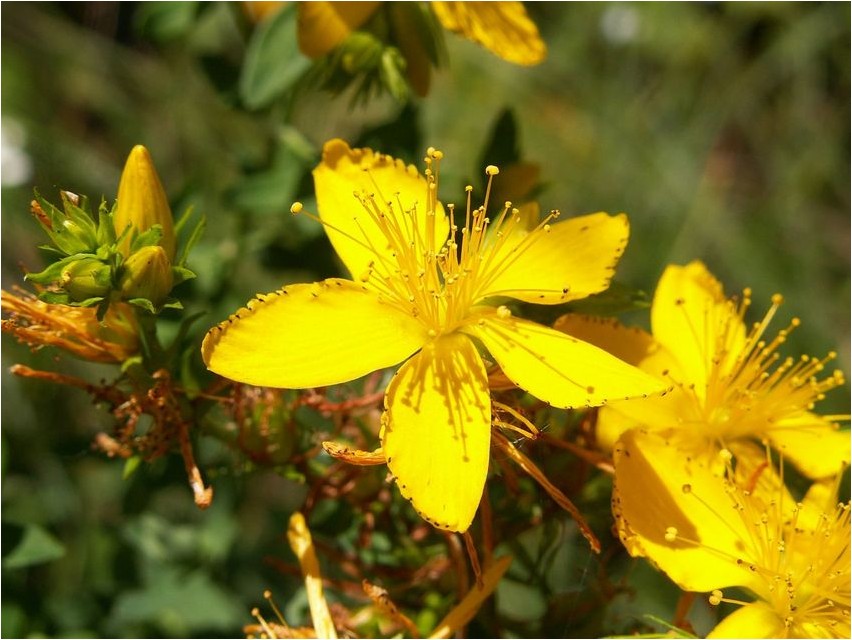
St. John’s wort is one of the plants of the family called St. John’s wort; in Latin the name of this plant will be as follows: Hypericum scarbrum L.
As for the Latin name of the St. John’s wort family itself, in Latin it will be like this: Hypericaceae Juss.
Description of St. John’s wort
St. John’s wort is a perennial herbaceous plant whose height varies between seventeen and forty centimeters. The stems of this plant are quite numerous and ascending, at the very base they will be woody, they are colored either brown or reddish. Such stems are rough and covered with hard glandular warts. The leaves of St. John’s wort are lanceolate, narrowly elliptical, oblong in shape or oblong-linear. Such leaves are covered with glands in the form of dots. The inflorescence of this plant will be corymbose-paniculate, the flowers are yellow in color and are numerous. The fruit of this plant is an ovoid or oblong=elliptical capsule, colored brown. The seeds of St. John’s wort are also brown and cylindrical in shape, and their ripening occurs from August to September.
This plant blooms from May to June. Under natural conditions, St. John’s wort is found in the Caucasus and Central Asia, as well as in the Altai region of Western Siberia. Under natural conditions, this plant is found on rocky outcrops, in thickets of rose hips and juniper, as well as on dry rocky slopes and in mountain steppes.
Description of the medicinal properties of St. John’s wort
St. John’s wort is endowed with very valuable healing properties, and it is recommended to use the herb of this plant for medicinal purposes. The term grass includes leaves, flowers and stems.
The presence of such valuable healing properties is explained by the content of alkaloids, essential oil, carotene, vitamin C, quercetin, rutin, quercitrin, hyperin, coumarins, tannins, catechins, hypericin, avicularin, anthocyanins, phloroglucinin, 7-arabinoside quercetin and 3-rutinoside myricetin in the plant. The roots of this plant contain alkaloids, and the inflorescences contain vitamin P.

As for traditional medicine, it is recommended to use the healing properties of this plant for various diseases of the liver, stomach, heart and bladder. A plaster should be prepared from the herb St. John’s wort in butter: such a plaster is recommended to be applied to wounds with bruises, ulcers, boils, abscesses and mastitis. An infusion of the flowers of this plant should be drunk as a tea for jaundice.
It is noteworthy that this plant is endowed with high antibacterial activity, as well as antiviral activity due to the amount of phenolic compounds. It was also experimentally proven that this plant has a moderate diuretic effect.
A ten percent tincture of St. John’s wort flowers has a bactericidal and bacteriostatic effect against Escherichia coli, streptococcus and Staphylococcus aureus.
It is worth noting that St. John’s wort is an essential oil and dye plant, which is used to obtain the following dyes: pink, red and yellow. The stems and leaves of this plant can color silk in honey and light yellow tones.
For colitis, the following remedy is used: to prepare it, take a tablespoon of dry crushed herb per glass of water. This mixture is boiled for three minutes and left for two hours, after which it is carefully filtered.





