Stephan’s Crane
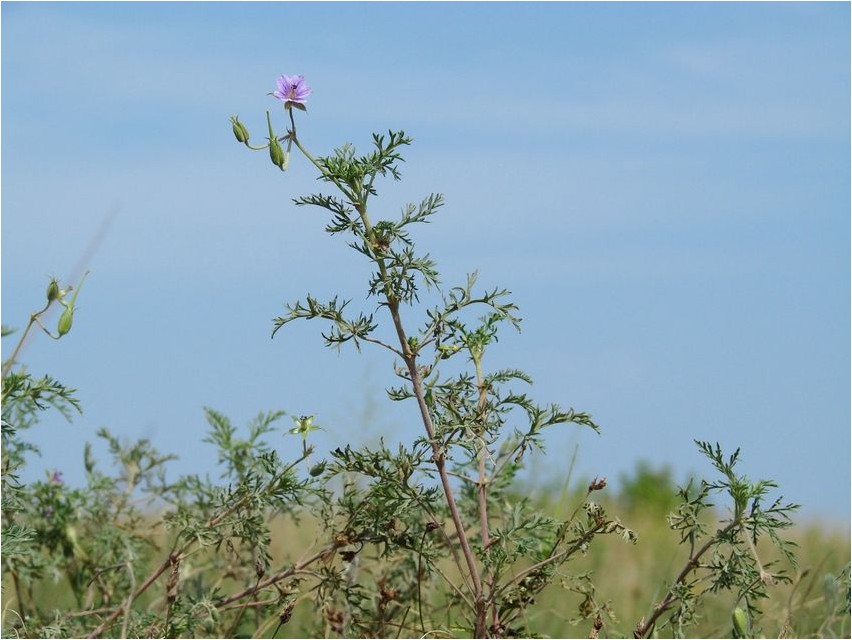
Stefani’s Crane is a member of the Geraniaceae family. Its Latin name is Erodium stephanianum Wild.
The Latin name of the Stephan’s Crane family is Geraniaceae Juss.
Description of Stephan’s Crane
Stefani’s Crane is a perennial plant with a pressed, flattened base and a mixture of fairly long, flattened hairs. The stems of this plant are ascending, reaching a height of about fifty to sixty centimeters. The leaves are ovate, bipinnately dissected into acute, lanceolate, and entire lobed leaflets, with segments running down the stem. The leaves are lilac-colored, six to eight millimeters long, the leaflets are one millimeter long, and the beak reaches 30 to 40 millimeters.
The flowering period of the Stephan’s cranesbill begins in July and ends in August. In the wild, the plant is found in the Altai region of Western Siberia, the Far East, Central Asia, and the Angara-Sayan and Daurian regions of Eastern Siberia. In terms of its general distribution, this plant is found in Tibet, Mongolia, Japan, the Korean Peninsula, and northwestern and northeastern China. Stephan’s cranesbill is most commonly found in the Irkutsk region, the Republic of Buryatia, and the Zabaikalsky Krai.
This plant prefers riverbanks, fallow lands, roadsides, steppes, and rocky slopes. The fruits ripen in September.
Description of the medicinal properties of Crane Stephanii
Cranium stephanii possesses highly valuable medicinal properties, and its herb is recommended for medicinal purposes. These valuable medicinal properties are due to the plant’s tannins and essential oil. It’s worth noting that the raw material is the entire dried aerial part of Crane Stephanii. This plant also contains quercetin and other flavonoids.

The plant helps relieve collateral circulatory blockages, stops diarrhea, and reduces rheumatic symptoms. Crane stephanii is also considered a valuable anti-inflammatory and astringent.
It was established through laboratory studies that a decoction based on the herb of this plant is endowed with antibacterial properties against the causative agents of dysentery, diplococcus and Staphylococcus aureus. As for traditional medicine, a decoction prepared from nine to fifteen grams of herb is recommended for use for minor injuries, rheumatic joint pain, acute gastroenteritis, corneal vesicular lichen, menstrual irregularities and inflammation of the sciatic nerve.
For all of the diseases listed above, including inflammation of the sciatic nerve and rheumatic pain in the joints, it is recommended to use a remedy based on stephan’s crane grass. To prepare such a remedy, you will need to take one hundred and twenty grams of herb per liter of vodka. The resulting mixture should be infused for five to seven days, after which this mixture is filtered very carefully. Take this remedy based on stefan’s crane grass twice a day, a small glass of about fifteen milliliters in volume. It should be noted that in order to achieve the greatest effectiveness when taking such a remedy, you should not only comply with all the standards for its preparation, but also strictly follow all the features of its administration.





