spoon grass
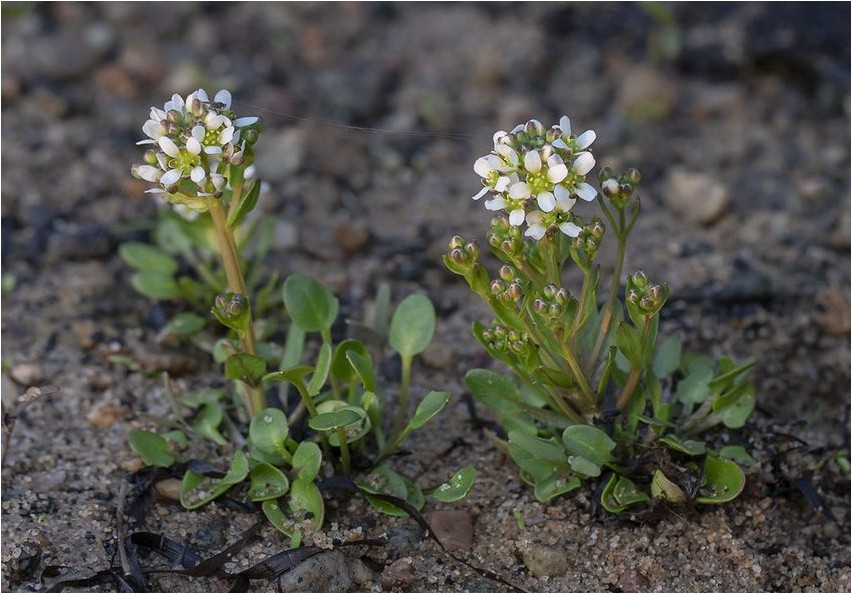
Spoon grass (lat. Cochlearia) is an annual or perennial plant of the Brassica or Cruciferous family. Other names are spoon horseradish, short grass, varukha, spoon horseradish, sea lettuce, cytot grass.
In nature, spoon grass is found on the coasts of the countries of North-Western and Western Europe, Novaya Zemlya, Iceland, North America, as well as in the mountainous regions of the Alps. It is cultivated everywhere, but in large quantities – in France, the Netherlands, Brazil and the USA. In Russia it is grown mainly on personal plots. Spoongrass is one of the plants that gravitates to cold climates.
Characteristics of culture
Spoongrass is a plant that forms a rosette of succulent leaves in the first year of life, and in the second year – a flowering stem and, accordingly, seeds. The basal leaves are rich green, numerous, oval or oblong-oval in shape, sitting on long petioles. The leaf blade is round, heart-shaped or narrowed at the base towards the petiole. Flowering stems reach a height of 15-40 cm.
The flowers are small, white, collected in racemose inflorescences at the top of the stem, 15-20 pieces each. The fruit is a rounded pod, up to 5-7 mm long, usually containing 6-9 seeds. The seeds are brown or red, oval, equipped with a hard tuberous shell, remain viable for 3-4 years. Spoongrass is characterized by increased cold resistance. Winter crops, covered with a thick layer of humus and snow, tolerate frosts down t o-40C.
Growing conditions

The spoonwort prefers drained, moist, clay or loamy soils. Grows well in shaded areas. Northern slopes are optimal. The culture has a negative attitude towards elevated temperatures.
Reproduction and sowing
Spoongrass is propagated by seeds. Seeds are sown in a row in early spring or autumn under cover in unprotected open ground, cultivated 2-3 weeks in advance. The distance between the rows should be 20-25 cm. The seeding depth is 1. 5-2 cm. The first shoots appear on the 10-14th day. Seedlings very quickly form a basal rosette of leaves, and after a year they begin to bloom profusely, usually in April-May (depending on climatic conditions).
Many experienced gardeners recommend sowing spoon grass in rows spaced 40-45 cm apart. Thinning is recommended when the seedlings develop 3-4 true leaves. Plants often self-seed; to prevent this, the seeds are collected when slightly immature, dried under a canopy or in a warm, dry room, and then threshed. Spoon grass is often grown as an annual. Perennial plants are replanted as needed. Harvesting takes place in the spring, or more precisely, at the beginning of flowering, literally within the first 2-3 days.
Care
Spoon grass care is standard: weeding, loosening the spaces between rows, fertilizing with mineral and organic fertilizers, pest and disease control, and, of course, watering. Watering is considered one of the most important procedures, as even in nature, the plant grows on coastal areas, meaning it does not tolerate drought. Applications
Spoonweed is widely used in folk medicine and cooking. It is prized for its rich composition. The plant contains a significant amount of vitamins, and holds the record for highest ascorbic acid content. The succulent leaves of spoonweed are used in salads, sauces, soups, vegetable dishes, and sandwiches.
Spoonweed
https://www. youtube. com/watch? v=uhcOTFUdjyE
Spoonweed





