Roundfoil
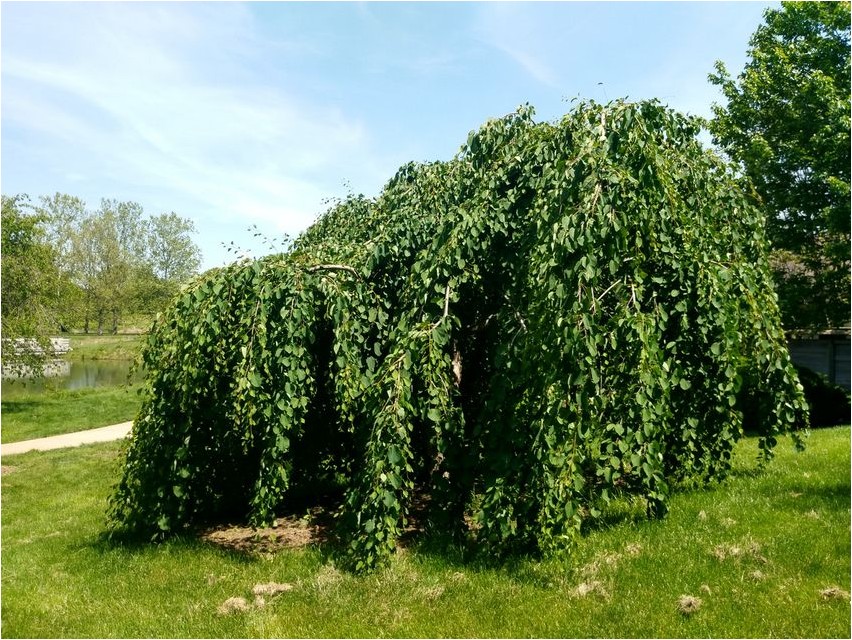
Roundfoil (lat. Cercidiphyllum) is a light-loving woody plant that is a representative of the Bagryannikov family. Other names are scarlet or “gingerbread tree.”
Description
Roundfoil is a rather spectacular deciduous tree. Its opposite leaves have a very attractive rounded-ovate shape.
Deprived of perianths, the small flowers of roundfoil are characterized by an irregular shape and are collected in bizarre brushes or bunches. Alas, the flowers of rotundifolia do not have sepals, much less petals. As a rule, the flowering of this beauty either precedes the process of formation of young leaves or coincides with it. And the fruits of this plant look like luxurious leaflets. Over time, cracking, they release many miniature seeds into free flight.
In total, the genus of roundfoil includes only two varieties of relict plants. By the way, roundfoil is often confused with the equally attractive cercis, but in fact these are completely different plants — they are representatives of not only different families, but also different genera. In principle, it is not so difficult to distinguish Cercis from roundleaf — the leaves of roundleaf are always opposite, while the leaves of Cercis are exclusively alternate.
Where does it grow
More than eighty million years ago, roundfoil could be found in very vast North American and Eurasian territories, but now its habitat has narrowed somewhat — now it can only be found in large quantities in Chinese or Japanese broad-leaved forests. In addition, roundfoil grows in the Mediterranean, North American spaces, as well as in East and Southeast Asia.
Usage
For plant growers, roundfoil is of particular interest as a spectacular park tree, which is ideal for creating magnificent compositional groups and for planting in both single and group plantings. In autumn, the foliage of this amazing plant acquires not only incredibly spectacular and completely incomparable shades, but also an impressive spicy aroma — this is why the inhabitants of Germany call the roundfoil “gingerbread tree”. By the way, just before they start to fall, the rotundifolia foliage smells even stronger and more pleasant! And one more no less interesting feature — the aroma of these trees can change depending on the shape of their crowns (for trees with umbrella crowns it will be one, for specimens with conical crowns it will be another, and for roundfoils with funnel-shaped crowns it will be a third). At the same time, some trees may have more pronounced honey notes, others may have cinnamon notes, and still others may have very peculiar notes of burnt sugar.

Growing and care
Flat, sunny areas are considered the most suitable for growing roundfoil, but it must be taken into account that with the onset of spring, the trunks of young seedlings may be damaged. As for soils, roundfoil will feel best on fertile soils with sufficient moisture, which are characterized by a slightly acidic or neutral reaction.
If the weather becomes too dry, the roundleaf will need regular watering. It is also recommended to feed trees with complete mineral fertilizers in the spring season. Sometimes the roundleaf is pruned, removing shrunken and diseased branches from the plants. And its propagation is carried out both by seeds sown with the onset of autumn, and by winter cuttings or layering.