Angelica silica
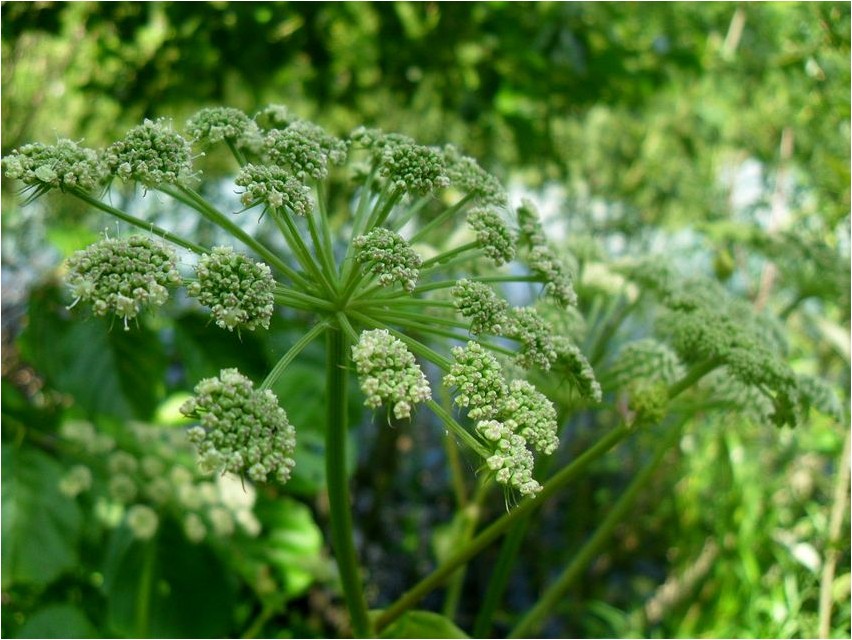
Angelica silica is one of the plants of the family called Umbellaceae; in Latin the name of this plant will be as follows: Angelica silvestris L.
As for the name of the angelica family itself, in Latin it will be: Apiaceae Lindl.
Description of angelica
Angelica silica is a biennial herbaceous plant endowed with a thick and short rhizome, as well as a thick, bare and straight stem. At the top, such a stem will be faceted, its color is greenish-gray, and there are red intercepts at the joints of the leaves. The basal leaves of this plant are complex, they can be either double- or triple-pinnate, while the upper leaves are endowed with a stem-encompassing sheath. The flowers are painted white, sometimes they can be creamy-pink; such flowers are collected in complex corymbose umbrellas, the diameter of which will be ten to sixteen centimeters. The fruit of this plant is a broadly oval two-seeded seed, compressed from the back, endowed with prominent median ribs.
It should be noted that the stems and rhizomes of angelica have a very specific odor. This plant blooms from June to July, while the fruits ripen in August-September. Under natural conditions, this plant can be found in the European part of Russia, with the exception of the Black Sea region, as well as in Moldova, Western and Eastern Siberia, Belarus and Ukraine. For growth, angelica prefers river valleys, mixed, small-leaved and broad-leaved forests, as well as wet meadows. In the steppes, the plant can grow only along river valleys.
Description of the medicinal properties of angelica
Angelica silica is endowed with quite valuable healing properties, and it is recommended to use the fruits, shoots and roots of this plant for medicinal purposes. As for traditional medicine, a decoction of the roots is used to treat respiratory diseases, laryngitis, hepatitis, bronchitis, gastric colitis, flatulence, gastritis, gastric and duodenal ulcers. Also, such drugs act as diuretics, expectorants and anthelmintics. Externally, these products can be used as compresses for lice, toothache and rheumatism.
The tincture of the roots is effective for insomnia and neuroses, for various diseases of the gallbladder, liver and digestive tract, and the tincture can also be used externally for rubbing and aromatic baths. Angelica silica root extract is endowed with antispasmodic and antitumor properties. The sap of the roots can be dropped into the ears as a pain reliever.

It is noteworthy that the young shoots of this plant can be eaten. The plant is endowed with the ability to increase blood clotting, as well as to enhance the secretion of gastric juice. For this reason, plant-based products should not be taken by people who have had a myocardial infarction.
For biliary dyskinesia, it is recommended to use the following remedy based on angelica silica: to prepare it, take twenty grams of crushed roots per liter of boiling water. The resulting mixture is infused for two hours and then carefully filtered. Take this remedy one glass three times a day as tea.
For insomnia, you should use a tincture based on angelica silica: to prepare such a remedy you will need to take one part of the crushed roots to five parts of seventy percent alcohol. This remedy is taken twenty to thirty drops three times a day.
Angelica sylvestris or Angelica silica
https://www. youtube. com/watch? v=NeS6-VOjuVo





