Manchurian Walnut
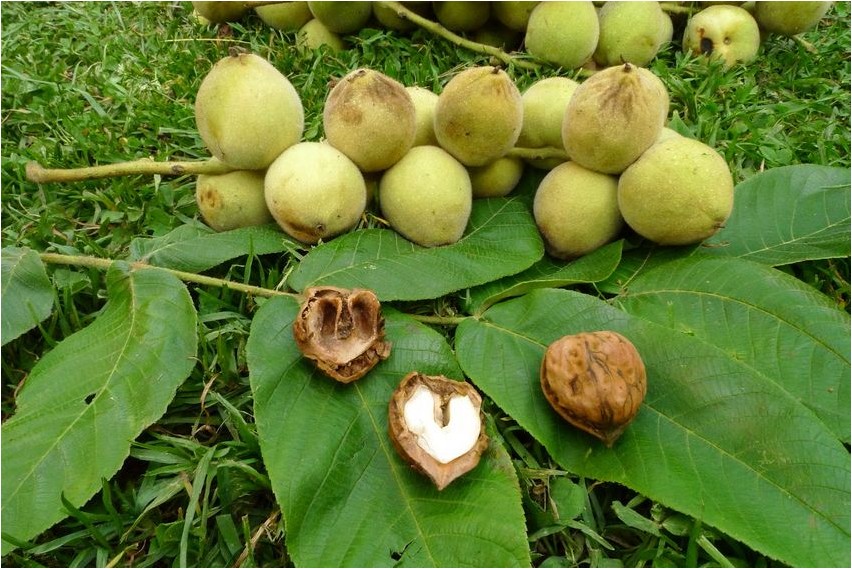
The Manchurian walnut (Juglans mandshurica) is a member of the genus Walnut in the Walnut family. It is also known as the Dumbey walnut.
It is native to northern China, Korea, the Russian Far East, Sakhalin, and North America. Typical habitats include cedar-broadleaf forests, river valleys, and the lower mountain belt. The average age is 250 years.
Culture Characteristics
The Manchurian walnut is a deciduous monoecious shrub or tree up to 30 m tall with a broadly rounded or spreading crown and a straight trunk with dark gray bark. The shoots are pubescent and yellowish-brown. The leaves are compound, petiolate, odd-pinnate, up to 90 cm long, and consist of 1-29 oblong-elliptical leaflets. The leaflets have serrated margins, and the leaf blade is serrated or finely serrated, tapering to a point.
The flowers are dioecious, small, and inconspicuous. Female flowers have bright pink stigmas and are borne in groups of 3-10 on short pedicels. Male flowers are clustered in long catkins. The Manchurian walnut tree blooms in April-May (the blooming time varies depending on the climate zone).
The fruit is a drupe-shaped, oval tree, similar to a walnut, with a thick green or brownish shell. The edible kernel contains up to 56% fatty oil. The fruits ripen in September-November. The tree begins bearing fruit 4-8 years after planting. Manchurian walnut trees bear fruit annually, with the average yield of a mature tree being 10-30 kg. The plant”s root system is robust, extending far beyond the crown as it grows. This is why the plants don”t respond well to transplanting, including large seedlings.
Growing Conditions
The Manchurian walnut tree thrives in full sun. Light shade will not harm the plants. The plant is undemanding regarding soil conditions, but produces good yields only in deep, well-drained, fertile, well-drained, humus-rich soils. The plants tolerate temporary water stress easily due to their deep root system. They tolerate short-term flooding. Heavy, clayey, waterlogged, and dry soils are undesirable for the Manchurian walnut tree.
Planting Seedlings
Before planting, seedlings need preliminary preparation. To do this, the tap root of the seedlings is cut off, leaving 30-40 cm. This procedure promotes the formation of additional lateral roots. Pruning is carried out using a special bracket. When planting a crop with nuts, instead of subsequently cutting the root, pinching is carried out. The planting hole is prepared in 2-3 weeks; an earthen roll is formed at its bottom, the mixture for which is made up of the top layer of soil, humus and sand with the addition of mineral fertilizers.
Propagation by seed
Manchurian nut seeds are sown in the fall. Before sowing, the seeds are sprayed with kerasin, this will prevent mice and other rodents from eating them. Spring sowing is not prohibited, but in this case stratification is required. It should be noted that seed germination during spring sowing is significantly lower than during autumn sowing. The embedding depth is 6-8 cm. The nut is placed edge-on in the hole. Up to 15 nuts are sown per 1 square meter.
Application
In the Russian Federation, Manchurian walnut is used for landscaping parks and alleys. The plant is also a frequent guest on personal plots. Walnut kernels are used for food purposes, including to obtain high-quality oil used in the confectionery industry. Manchurian walnut wood is a particularly valuable material; furniture, plywood and various crafts are made from it.
Manchurian walnut or “Jupiter”s acorn”
Manchurian Walnut
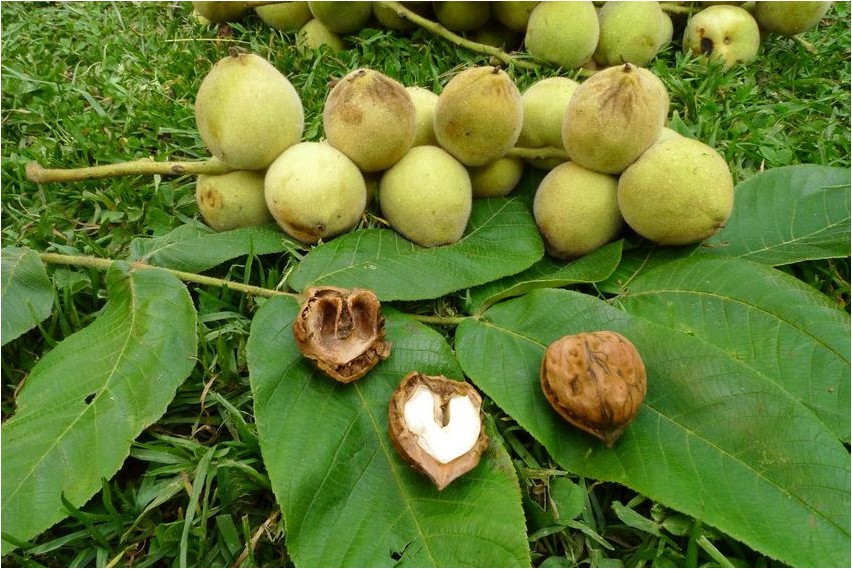

The Manchurian walnut (Juglans mandshurica) is a member of the genus Walnut in the Walnut family. It is also known as the Dumbey walnut.
It is native to northern China, Korea, the Russian Far East, Sakhalin, and North America. Typical habitats include cedar-broadleaf forests, river valleys, and the lower mountain belt. The average age is 250 years.
Culture Characteristics
The Manchurian walnut is a deciduous monoecious shrub or tree up to 30 m tall with a broadly rounded or spreading crown and a straight trunk with dark gray bark. The shoots are pubescent and yellowish-brown. The leaves are compound, petiolate, odd-pinnate, up to 90 cm long, and consist of 1-29 oblong-elliptical leaflets. The leaflets have serrated margins, and the leaf blade is serrated or finely serrated, tapering to a point.
The flowers are dioecious, small, and inconspicuous. Female flowers have bright pink stigmas and are borne in groups of 3-10 on short pedicels. Male flowers are clustered in long catkins. The Manchurian walnut tree blooms in April-May (the blooming time varies depending on the climate zone).

The fruit is a drupe-shaped, oval tree, similar to a walnut, with a thick green or brownish shell. The edible kernel contains up to 56% fatty oil. The fruits ripen in September-November. The tree begins bearing fruit 4-8 years after planting. Manchurian walnut trees bear fruit annually, with the average yield of a mature tree being 10-30 kg. The plant”s root system is robust, extending far beyond the crown as it grows. This is why the plants don”t respond well to transplanting, including large seedlings.
Growing Conditions
The Manchurian walnut tree thrives in full sun. Light shade will not harm the plants. The plant is undemanding regarding soil conditions, but produces good yields only in deep, well-drained, fertile, well-drained, humus-rich soils. The plants tolerate temporary water stress easily due to their deep root system. They tolerate short-term flooding. Heavy, clayey, waterlogged, and dry soils are undesirable for the Manchurian walnut tree.
Planting Seedlings
Before planting, seedlings need preliminary preparation. To do this, the tap root of the seedlings is cut off, leaving 30-40 cm. This procedure promotes the formation of additional lateral roots. Pruning is carried out using a special bracket. When planting a crop with nuts, instead of subsequently cutting the root, pinching is carried out. The planting hole is prepared in 2-3 weeks; an earthen roll is formed at its bottom, the mixture for which is made up of the top layer of soil, humus and sand with the addition of mineral fertilizers.
Propagation by seed
Manchurian nut seeds are sown in the fall. Before sowing, the seeds are sprayed with kerasin, this will prevent mice and other rodents from eating them. Spring sowing is not prohibited, but in this case stratification is required. It should be noted that seed germination during spring sowing is significantly lower than during autumn sowing. The embedding depth is 6-8 cm. The nut is placed edge-on in the hole. Up to 15 nuts are sown per 1 square meter.
Application
In the Russian Federation, Manchurian walnut is used for landscaping parks and alleys. The plant is also a frequent guest on personal plots. Walnut kernels are used for food purposes, including to obtain high-quality oil used in the confectionery industry. Manchurian walnut wood is a particularly valuable material; furniture, plywood and various crafts are made from it.