Loosestrife
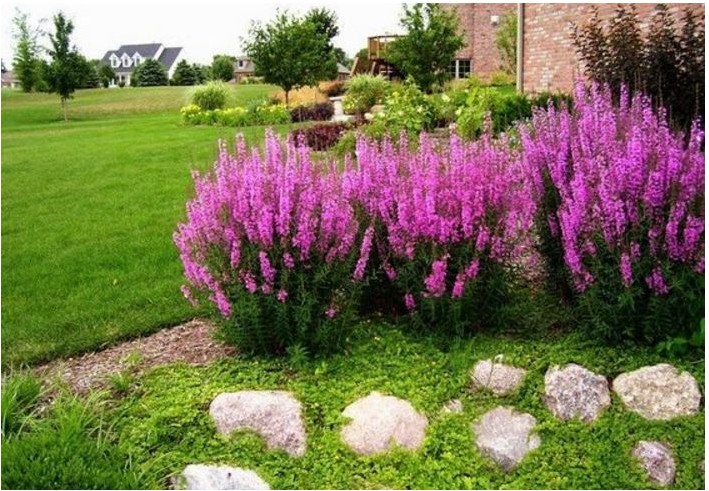
Loosestrife is one of the plants of the family called loosestrife; in Latin the name of this plant will be as follows: Lithrum salicaria L.
As for the name of the loosestrife family itself, in Latin it will be: Lithraceae Jaumo.
Description of loosestrife
Loosestrife is a perennial herbaceous plant endowed with a thick woody rhizome. The height of the stem of this plant will vary between fifteen and one hundred centimeters; such a stem will be hexagonal and erect. The leaves of loosestrife will be sessile and lanceolate, with the lower leaves being whorled or opposite, and the upper leaves being alternate. The flowers of this plant are very showy and are colored in red-lilac tones; such flowers are collected at the top of the stem and at the ends of the branches in rather long and dense, intermittent, racemose whorls. The fruit of this plant is an oval-shaped capsule.
Flowering loosestrife occurs in the period from July to August. Under natural conditions, this plant is found in the Caucasus, Western Siberia, Central Asia, Ukraine, the Far East, Belarus, the European part of Russia, as well as the Yenisei region of Eastern Siberia. To grow, loosestrife prefers sedge swamps, rice fields, banks of shallow rivers, water meadows, coastal strips among aquatic vegetation or willow thickets, and is sometimes found on sand near the seashore. It is noteworthy that loosestrife is not only an ornamental plant, but is also a perganos and honey plant.
Description of the medicinal properties of loosestrife
Loosestrife is endowed with very valuable healing properties, and it is recommended to use the rhizomes and grass of this plant for medicinal purposes. The term grass includes leaves, stems and flowers. It is recommended to harvest the grass throughout the entire flowering period, while the rhizomes should be prepared already in the autumn.
The presence of such valuable healing properties is recommended to be explained by the content of saponins and tannins in the rhizomes of loosestrife, while the aerial part of this plant contains tannins, resin, glucose, carotene, mucus, vitamin C and salikarin glycosides.

A decoction, tincture, and infusion prepared from the herb and flowers of loosestrife are recommended for use as a diuretic, astringent, analgesic, antibacterial, and anti-inflammatory agent. These remedies are also used for various venereal diseases, headaches, colds, colic, gastralgia, gastroptosis, menorrhagia, and as an antidote for rabid animal and snake bites. An infusion prepared from the leaves and fresh roots of loosestrife is recommended for use as a poultice on wounds and bruises.
In homeopathy, preparations based on this plant are used as astringents. In folk medicine, infusions and decoctions of loosestrife are used for rheumatism, leucorrhoea, massive hematuria, nervous disorders, rabies, hemorrhoids, typhoid, dysentery, chronic inflammation of the mucous membranes of the gastrointestinal tract and upper respiratory tract. It is also used for epilepsy and applied externally to eczema, varicose ulcers, fissures, and for bathing excited and weakened children. It should be noted that these remedies are quite effective when used correctly.





