Rhododendron golden
Golden rhododendron is one of the plants of the family called heathers; in Latin the name of this plant will be as follows: Rhododendron aureum Georgi.
As for the name of the golden rhododendron family itself, in Latin it will be: Ericaceae Juss.
Description of golden rhododendron
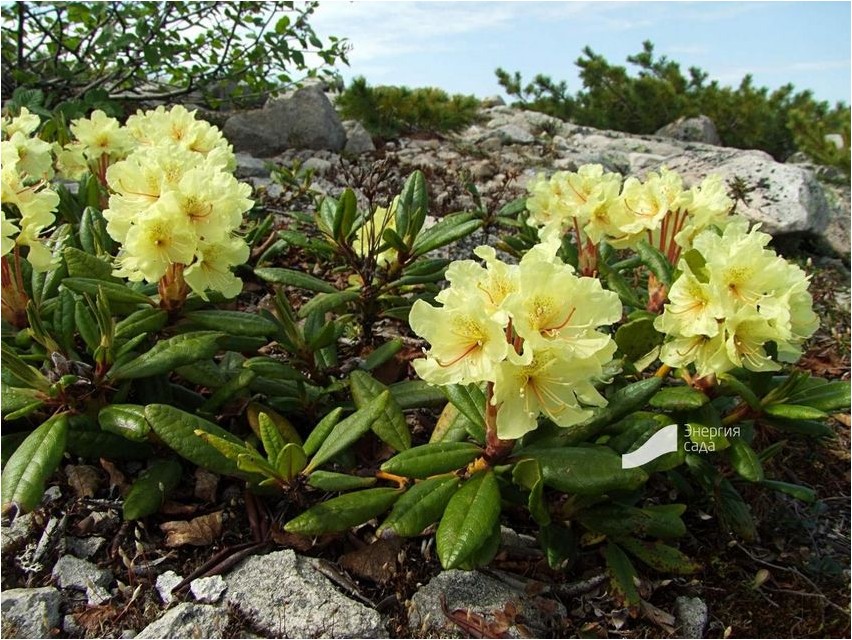
Golden rhododendron is known by the popular names blackmane, kashkara, kashkarnik and pandarva. Golden rhododendron is an evergreen shrub whose height can reach eighty centimeters. Such a plant will be endowed with dark brown bark and almost creeping branches. The leaves of the golden rhododendron are thick, entire, short-petioled, leathery and glabrous on both sides. Above, such leaves of this plant will be shiny and dark green, but below they are paler, obovate or long-elliptical. At the base, the leaves will be wedge-shaped, they are endowed with reticulate venation or an edge turned down; the length of such leaves will be about three and a half to seven centimeters, and the width will be equal to one to two and a half centimeters.
The flowers of this plant will be broadly bell-shaped and large, they are colored in light yellow tones, and the diameter of such flowers reaches three to five centimeters. Such golden rhododendron flowers will be collected in approximately five to ten pieces in umbrella-shaped inflorescences at the very ends of the branches. The fruit of this plant is a five-locular oblong capsule, which is initially reddish-woolly, and then becomes almost smooth. Golden rhododendron seeds will be numerous and quite small in size.
This plant blooms from May to June, while the fruits ripen from July to August. Under natural conditions, golden rhododendron is found in the Far East, Eastern Arctic, Eastern Siberia and the Altai region of Western Siberia. For growth, this plant prefers the upper part of the forest belt, subalpine and alpine meadows. It is noteworthy that quite often golden rhododendron will form thickets.
Description of the medicinal properties of golden rhododendron
Golden rhododendron possesses valuable medicinal properties, and its herb is recommended for medicinal purposes. The herb includes the flowers, stems, and leaves. These valuable medicinal properties are attributed to the leaves’ content of tannins, sitosterol, triterpenoids, vitamin C, essential oil, silver, lead, copper, barium, glycosides, aluminum, and manganese.

Preparations based on this plant have been shown to increase diuresis, improve blood flow, reduce shortness of breath, normalize cardiac function, and promote the elimination of edema. Furthermore, infusions, tinctures, and liquid extracts of golden rhododendron reduce venous pressure and have a pronounced effect on the heart. The plant has a fairly strong bactericidal effect against staphylococci, pathogenic intestinal flora, and streptococci. Preparations based on golden rhododendron are effective in treating various oral mucosal conditions, including gingivitis and stomatitis. However, it should be remembered that such preparations are highly toxic.
Traditional medicine uses tinctures made from the stems and leaves of this plant for insomnia, gout, rheumatism, dropsy, irritability, epilepsy, headaches, tuberculosis, women’s diseases, and fever.