Ageratum
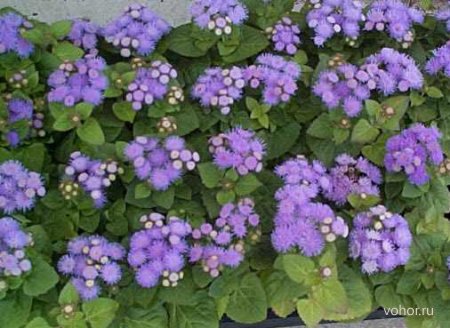
Ageratum is grown as an annual plant. The flower is easy to grow, easy to propagate, and has a long flowering period.
The plant genus has more than 50 species. In floriculture, the most common ageratum is Houston or Mexican.
Care and cultivation of ageratum
It is best to grow ageratum in sunny, wind-protected areas or in light shade.
Prefers light, nutritious, not very acidic soils.
Water moderately, avoiding waterlogging of the soil.
It can do without fertilizing, but for better flowering and growth, it is fed every week with complex mineral fertilizers. It is not recommended to fertilize with fresh manure. Periodically, the soil under the plant is loosened and weeded.

Reproduction
Ageratum is propagated by seeds and planted as seedlings in open ground. Seeds are sown at the end of March or beginning of April in a container with a loose substrate made from a mixture of sand, peat and humus. The seeds are simply distributed over the surface of the substrate, without deepening, or lightly sprinkled with soil on top. After sowing, containers with seeds are covered with film or glass on top. Seeds are germinated in a bright place at a temperature of about 18-22 degrees. Periodically, the seeds are watered and ventilated. After germination, the film or glass is removed. In the phase of two pairs of true leaves, the plants are planted in separate containers. Plants are planted in open ground at the end of May, after the threat of frost has disappeared. Seedlings are planted at a distance of 15-20 cm from each other. For greater tillering, the tops of plants can be pinched.
To preserve varietal characteristics, ageratum can be propagated by cuttings. In this case, the bush is dug up in the fall, transplanted into a pot and kept indoors at room temperature all winter. Cuttings are carried out in the spring, usually in March. Cut cuttings are rooted in a loose substrate at a temperature of 18-20 degrees. At the end of May. plants are planted in open ground.
Diseases and pests
Ageratum can suffer from aphids, spider mites, and whiteflies. scoops. Sometimes it can be affected by root rot and nematodes.