Ledum
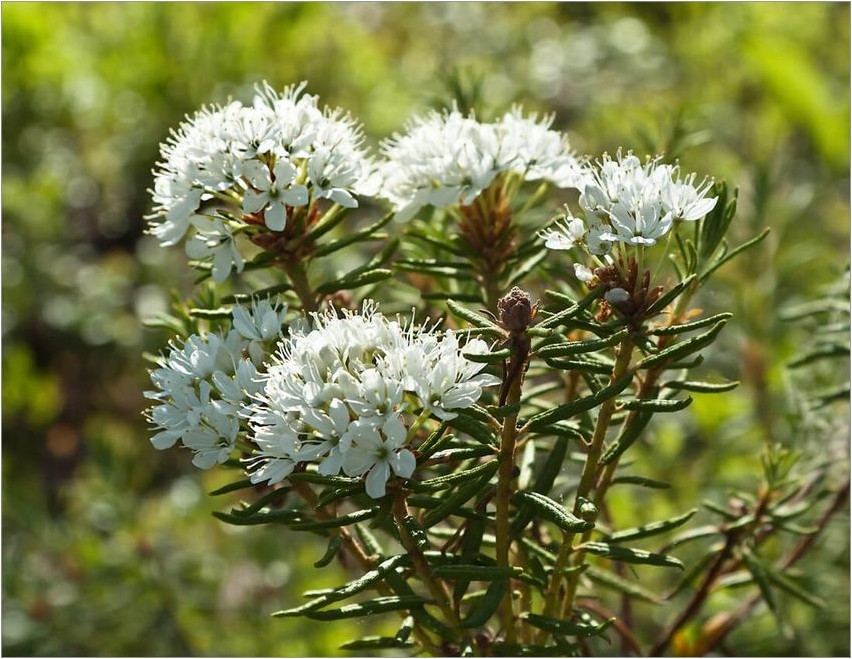
Ledum (lat. Ledum) is a beautifully flowering fragrant plant belonging to the Heather family. Another name is wild rosemary.
Description
Ledum is an evergreen, strongly branching shrub, endowed with slightly erect shoots and rather dark, fragrant lanceolate leaves. Its recumbent stems take root, gradually growing in all directions, and it is from them that the above-mentioned rising shoots emerge. Newly appeared branches are always thickly covered with a pleasant reddish fluff. In addition, with age, the bark of some shrubs becomes bare and turns into an unremarkable grayish-brownish tones.
Small ellipsoidal or linear leaves of ledum sit on very strong short petioles. The edges of the leathery leaf blades are slightly curved, and their front surfaces are always glossy, with golden-colored veins clearly visible to the eye. As for the underside of the leaves, it is usually pubescent.
Ledum usually begins to bloom in April — its graceful five-petal flowers boast a very delicate white or pinkish color. The fragrant flowers of this plant form spectacular umbrella-shaped inflorescences. As for ledum fruits, they look like miniature boxes filled with a huge number of flat seeds.
In total, the ledum genus has eight species.
Where does it grow
Ledum is most often found in the Northern Hemisphere. This plant is especially widespread in the forest and tundra zones of Russia. And very harsh climatic conditions are absolutely no obstacle to beautiful ledum!

Usage
Since ledum is a beautifully flowering plant, it is quite actively used in ornamental gardening. And the sufficiently high content of tannins and essential oils allows it to be considered a medicinal plant, however, it should be remembered that in general ledum is a poisonous plant.
It is important not to forget that the branches and leaves of ledum emit a fairly strong intoxicating aroma; therefore, prolonged exposure to this plant can provoke nausea, dizziness or headache, and sometimes fainting.
Growing and care
It is best to plant ledum in sunny, but at the same time slightly shaded areas characterized by “heathery” acidic soils. But on soils enriched with lime, it clearly will not produce good growth, since it is a calcephobe. It is noteworthy that the level of illumination does not have the slightest effect on the full development of this plant or on its decorative effect.
With the onset of spring, the plant needs good feeding, and when dry summer weather sets in, timely watering will not be superfluous (water it approximately once a week, and quite generously). And after watering, it doesn’t hurt to take care of proper mulching. Ledum does not have the slightest need for pruning, however, with the onset of spring it is better to cut off all the frozen branches found on the plant.
Ledum is propagated either by seeds or by summer cuttings using phytohormones. The easiest way to propagate ledum is by dividing the bushes. In addition, it reproduces well by self-sowing. True, the winged seeds of ledum often not only scatter to different sides of the site, but also fly far beyond its borders, so everyone who wants to collect good planting material will have to take care of this in advance. And the best time to plant this plant, of course, is spring.