Falsa
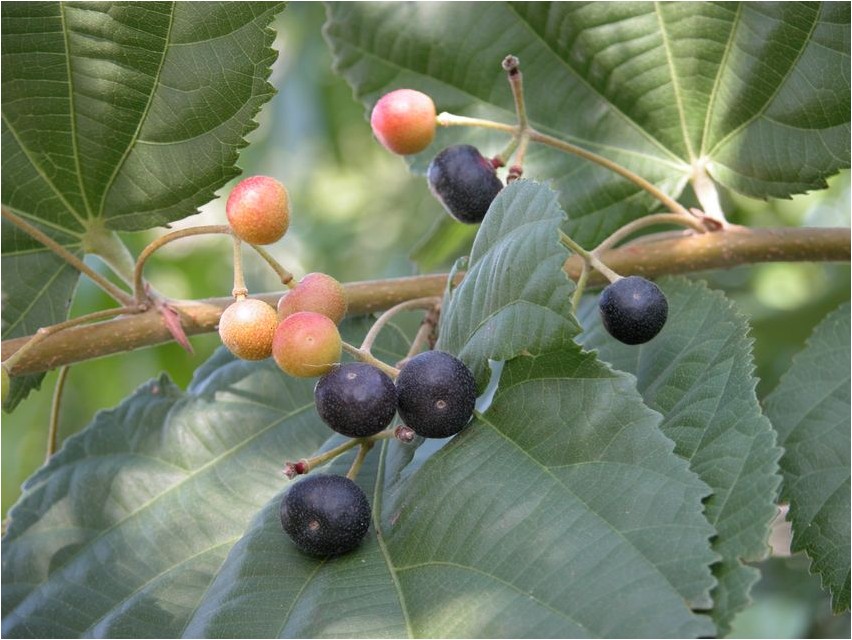
Falsa (lat. Grewia subinaequalis) is a fruit tree belonging to the Malvaceae family.
Description
Phalsa is a small deciduous tree whose height rarely exceeds four and a half meters. It is noteworthy that in the tropical zone the phalsa is always evergreen, and in the subtropical zone it drops its leaves from time to time for a month and a half.
The jagged leaves of this culture are oval or heart-shaped and are colored whitish on the lower sides. In most cases, their width reaches about 16. 25 cm, and their length is about twenty centimeters.
The diameter of the rounded fruits (more precisely, spherical drupes) of the phalsa is approximately 1. 25 — 1. 6 cm. The peel of unripe fruits has a purplish-reddish color, and closer to the moment of ripening it turns dark purple, almost black tones. The fibrous soft pulp inside the fruit is colored greenish-whitish, and in the immediate vicinity of the skin it has purplish-reddish tints. In addition, each fruit contains a pair of large seeds. If the fruits of the phalsa are overripe, then their entire flesh turns purplish-red. And the pulp always tastes sweet and sour.
Where does it grow
Falsa grows everywhere in the countries of Southeast Asia and India, and you can equally often find it both in cultivation and in the wild. This plant is especially active in mountainous areas. As for the commercial cultivation of phalsa, it is concentrated mainly near Bombay and in the Punjab. Relatively recently, falsa was introduced to the distant Philippines and even to Australia. And in countries located on the American continent, this culture is extremely rare.
Application
Most often, phalsa fruits are eaten fresh. In addition, they are actively used in the production of various syrups and soft drinks, and if you mix them with sugar, you get incredibly tasty squash or sherbet. By the way, unripe fruits cannot be eaten.

Unripe phalsa fruits are often used as a sedative and antipyretic. In addition, they have excellent anti-inflammatory and astringent effects. The latter property makes falsa an excellent remedy for dysentery and diarrhea.
The high potassium content and some other biologically active compounds make phalsa recommended for those suffering from kidney disease—it quickly helps relieve swelling. These unique fruits are also helpful for fevers and cardiovascular diseases.
To normalize blood sugar levels, a decoction is prepared from the bark of this plant. The leaves should also not be thrown away—they can be used as compresses for suppurations and various rashes or inflammations.
Contraindications
No serious contraindications to the consumption of phalsa have been identified at this time, with the exception that these fruits are not recommended for those with obesity or diabetes. The fruits also contain substances that can cause allergies, so it is advisable to enjoy these fruits with some caution—for those with an individual intolerance to this product, it can easily cause some discomfort. Growing
Phalsa is a relatively easy-to-grow crop, able to tolerate both drought and frost equally well. It grows best in regions with subtropical or tropical climates. It”s important to note that phalsa is considered a fairly light-loving plant. It begins to bear fruit around the second or third year of growth.
Why doesn”t phalsa have gravity in its third season?