Kalanchoe daigremontiana
Kalanchoe daigremontiana is sometimes known by other names, such as “doctor” and even “bryophyllum.” This plant belongs to the Crassulaceae family, and its Latin name is Crassulaceae.
The Latin name for the plant itself is Kalanchoe daigremontiana.
Growing Instructions
Regarding light requirements, Kalanchoe daigremontiana requires either full sun or partial shade. In summer, moderate watering is recommended, and humidity should be maintained at a moderate level. Kalanchoe daigremontiana is a leafy succulent.
This plant is recommended for growing not only indoors but also in public spaces, on bright windowsills. During the summer, it can be used as a balcony decoration. This plant is also a wonderful element for creating beautiful compositions and groups consisting of other succulents. Kalanchoe daigremonii is also often found in winter gardens and greenhouses.
As for the maximum height of this plant in cultivation, it can reach up to seventy centimeters. It will require repotting every two years, and it is recommended to use standard-sized pots. Regarding the soil composition itself, Kalanchoe daigremonii requires the following soil: one part turf and leaf mold, and one part sand. The acidity of this soil can be neutral or slightly acidic.
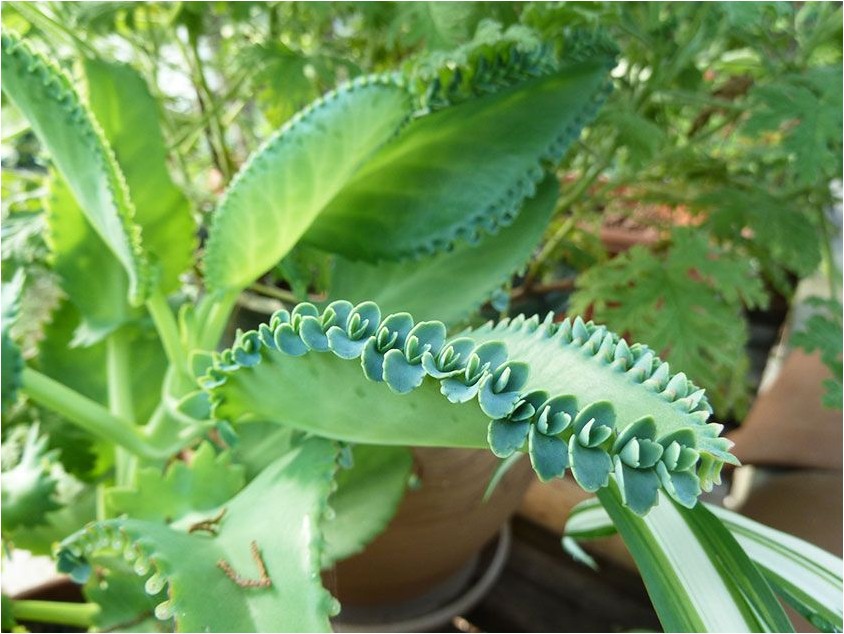
It is important to remember that the plant can stretch quite a bit; for this reason, Kalanchoe daigremonii will require pinching. It is important to note that corky growths may appear on both the leaves and stems. This unpleasant situation can occur due to low temperatures and sharp fluctuations in both air and soil humidity. If both air temperature and soil moisture are elevated, Kalanchoe degremonii may be affected by rot. The plant can quickly become a weed on the windowsill, as Kalanchoe degremonii can spread so-called brood buds across all pots located near the plant itself.

Throughout the rest period, the optimal temperature should be maintained at ten to fifteen degrees. In this case, during this entire period, the air humidity should be average, and Kalanchoe degremona should be watered extremely rarely. If Kalanchoe degremona is grown indoors, the dormant period becomes forced and occurs due to the fact that air humidity and light levels are reduced. This period of rest will last from October to February.
Reproduction of the plant most often occurs with the help of brood buds that form on the leaves. Much less frequently, propagation of Kalanchoe degremona can occur through rooting of apical cuttings. It is important to note that for the favorable development of this plant, it will need to be provided with moderate watering and fairly bright lighting. Both the leaves and flowers of Kalanchoe degremona are endowed with decorative properties.
The leaves reach about twenty centimeters in length, they will be elongated-elliptical in shape, and also fleshy; sometimes such leaves are folded along their midrib. In color, the leaves of Kalanchoe degremona are grayish-green, with purple spots at the bottom, the leaves themselves are bare, endowed with brood buds, the formation of which occurs along the edge of the leaf.