Angelica macrolobata
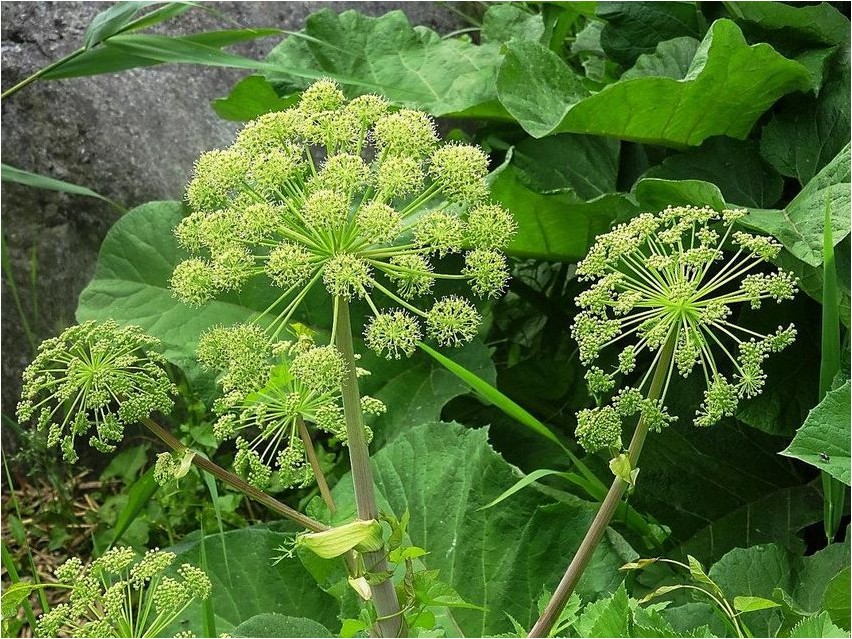
Angelica macrolobata is one of the plants of the family called Umbellaceae; in Latin the name of this plant will be as follows: Angelica grosseserrata Maxim.
As for the very name of the angelica macrolobate family, in Latin it will be like this: Apiaceae Lindl.
Description of Angelica macrolobata
Angelica macrolobata is a perennial herbaceous plant, the height of which will fluctuate between sixty and one hundred and fifty centimeters. The stems of this plant are bare, rounded and branched. The leaves can be either double- or triple-triple-dissected, they will be broadly triangular in outline, and their width will be about thirty-six to forty centimeters. The lower leaves are on petioles, which will gradually turn into a stem-encompassing sheath. The umbrellas of Angelica macrolobata are endowed with ten to twenty rough-pubescent rays, which are about six to seven centimeters in diameter.
The involucre of Angelica crunodolata will consist of five to seven narrow-lanceolate or linear leaves. The petals are almost round and they are painted white, at the base the petals taper into a very narrow nail, and at the top they will be notched with a lobe bent inward. The fruits of this plant are almost quadrangular, their length is slightly more than six millimeters and their width is five millimeters. Angelica macrolobata blooms in August, while the fruits will ripen around September-October.
Under natural conditions, this plant is found in the Far East, namely in the south of Primorye. For growth, angelica macrolobata prefers valley oak and broad-leaved forests, seaside cliffs, thickets of bushes and rocky slopes.
Description of the medicinal properties of Angelica macrolobata
Angelica macrolobata is endowed with very valuable healing properties, and it is recommended to use the roots of this plant for medicinal purposes.

As for traditional medicine, a decoction and infusion of the roots of this plant is used as a sedative, anti-inflammatory and analgesic, as well as a diaphoretic for various respiratory infections. It is noteworthy that it has been proven that the root extract of Angelica macrolobata is endowed with antitumor activity.
As a diaphoretic for respiratory infections and as a pain reliever for rheumatism, the following remedy based on angelica macrolobata is recommended: to prepare this remedy, take two tablespoons of crushed roots per half a liter of water. Boil the resulting mixture for four to five minutes, then let it steep for two hours, then strain thoroughly. Take one-third of a glass of this remedy in slow, small sips three to four times daily.
As a pain reliever, apply fresh juice of this plant on a cotton ball to an aching tooth or put two or three drops in the ear.
Angelica macrolobata can also be used as a fairly effective expectorant, analgesic, and antispasmodic. To prepare this remedy, use twenty to twenty-five grams of crushed roots and rhizomes per liter of boiled water at room temperature. The resulting mixture should be left to steep for eight hours, then thoroughly strained. Take one-third of a glass of this remedy. For this remedy to be effective, all preparation instructions must be followed.





