Metrosideros
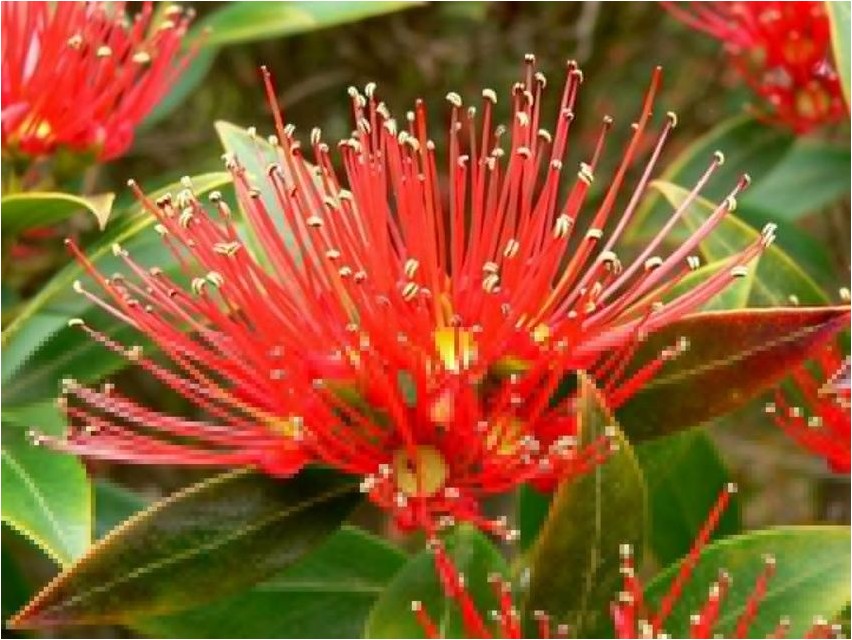
Metrosideros (lat. Metrosideros) is a deciduous evergreen tree belonging to the Myrtaceae family. Its second name is Christmas tree.
Description
Metrosideros is a deciduous evergreen tree. However, it can look like not only a tree, but also a vine. And the specimens growing on coastal cliffs are almost always low shrubs.
Metrosideros flowers are collected in small racemes or umbrellas, and their stamens are almost always bright red (although sometimes other shades are also found). Thin threads of stamens give these flowers an amazing decorative effect!
The most common varieties of Metrosideros are Metrosideros tall and Metrosideros polymorpha. The first, by the way, justifies the name given to it entirely, since its height can reach twenty-three meters. And Metrosideros polymorpha is a luxurious, highly branched bush.
Where does it grow
Metrosideros can be seen on dunes and rocky cliffs, as well as in bushes or coastal forests. As for its habitat, it is not difficult to find this plant in New Zealand, New Guinea, New Caledonia and Hawaii. In addition, Metrosideros is found in South Africa, as well as on a number of small Pacific islands.
Usage
Metrosideros is actively used as decoration in a truly incredible number of seaside resorts — this is due to its extreme resistance to not always favorable coastal conditions (fog, etc.).

Growing and care
Metrosideros is extremely partial to sunlight and does not need shading at all. In summer, it can be safely placed outside, in areas protected from the winds, and in winter, it will feel best in a cool room, where the temperature is in the range of five to ten degrees.
As for watering, in winter it should be moderate (the soil should remain slightly moist and not dry out completely), and from spring until autumn — abundant. If suddenly a beautiful plant begins to shed flowers or leaves, you need to carefully examine the earthen ball — the cause of this situation can be either excessive drying or excessive watering. In the latter case, the roots of the plant may also begin to rot.
Close attention should also be paid to air humidity — metrosideros loves high humidity. To achieve the required level of humidity, it is recommended to spray the air around it from time to time, making sure that splashes of water never fall on the plant itself.
This plant can be propagated either by cuttings or by seeds. Cuttings for these purposes are usually cut from March to June, and the best temperature for growing them is twenty-five degrees. As a rule, plants propagated in this way begin to bloom after three to four years, not earlier. It is also important to know that growing metrosideros from cuttings is a very difficult and troublesome task.
However, propagation by seeds will also require a lot of patience — their germination often takes from one to three months. It is best to try to sow the seeds in February or March, deepening them 1 — 2 millimeters into a fresh peat mixture. And the temperature at this moment should ideally not exceed eighteen degrees.
And a little about pruning — adult specimens are usually pruned after their flowering is completed, and young ones are gradually formed throughout the year.