Euphorbia severtsova
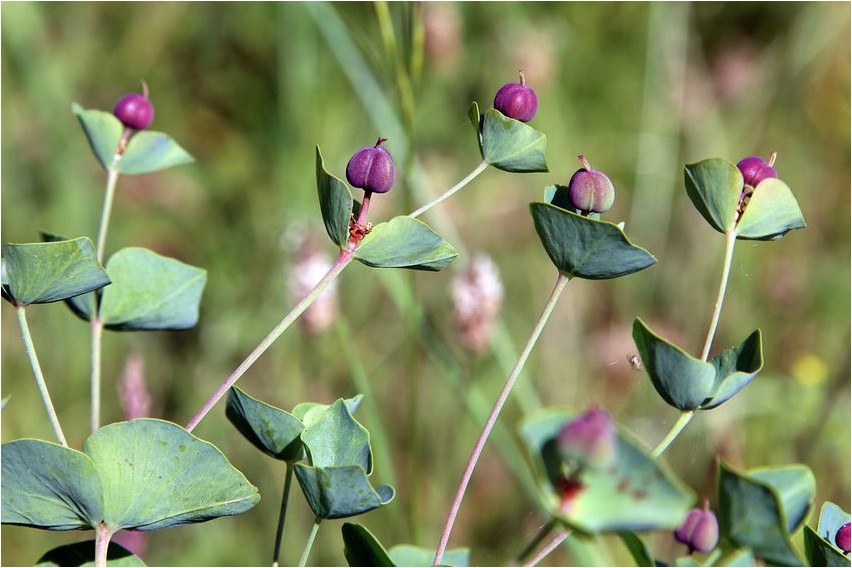
Euphorbia severtsova is one of the plants of the family called Euphorbiaceae; in Latin the name of this plant will be as follows: Euphorbia sewerzowii Herd. ex Prokh.
As for the name of the milkweed family itself, in Latin it will be: Euphorbiaceae Juss.
Description of milkweed severtsova
Euphorbia severtsova is a perennial herbaceous plant, the height of which will fluctuate between twenty-six and seventy centimeters. Such a plant is naked, and its stems will be erect, their thickness will be about four to five millimeters, at the bottom they will most often be naked, and at the top they will be endowed with axillary peduncles. The lower leaves of Euphorbia severtsova are scale-like and obtusely triangular, while the stem leaves will be alternate; they can be either triangular-lanceolate or triangular-deltoid. The length of the leaves of this plant will be about two to four centimeters, and the width will be approximately one to two and a half centimeters. The apical peduncles of Euphorbia severtsova will be seven to ten in total, their length will be about five to twelve centimeters, just like the axillary peduncles at the end they will be bipartite. The glass of this plant is bell-shaped, and its diameter is approximately two and a half to three millimeters. The three-nut is obtuse-ovate, its length is five to six centimeters, and the seed is ovoid, its length in turn will be about three to four millimeters. Such a seed will be smooth and endowed with a small disc-shaped sessile appendage.
Euphorbia severtsova blooms in June. Under natural conditions, this plant is found in Central Asia. For the growth of milkweed, Severtsova prefers places among bushes, rocky and gravelly slopes, in the mid-mountain and upper mountain zones.
Description of the medicinal properties of milkweed severtsova
Euphorbia severtsov is endowed with very effective healing properties, and the presence of such valuable healing properties is recommended to be explained by the content of catechins, tannins, rubber, as well as the following flavonoids in this plant: tetracosanol, quercetin, hyperin and triacontan. The seeds of the plant will contain fatty oil.
Euphorbia severtsova is endowed with emetic, laxative and analgesic effects, and is also taken for various heart and gastrointestinal diseases. Aqueous and hydroalcoholic extracts, as well as an alcoholic tincture based on Euphorbia severtsov, are considered to have choleretic and laxative effects. It should be noted that the resins of this plant will have epilating properties. It is noteworthy that Euphorbia Severtsova has the ability to color fabrics in yellow-green tones.

For cholecystitis and gastritis, it is recommended to use the following very effective remedy based on this plant: to prepare such a healing remedy, you will need to take two grams of crushed Euphorbia severtsova herb per glass of water. The resulting healing mixture should be boiled for about five minutes, then this mixture is left to infuse for at least one hour, after which this healing mixture based on this plant should be filtered very carefully. Take the resulting medicine based on milkweed severtsov two to three times a day, one tablespoon.
The following remedy is used as a laxative and choleretic agent: five grams of dry herb per glass of alcohol is left to infuse for ten to twelve days. Take this healing remedy two times a day, eight to ten drops diluted with water.