Eucalyptus variegated
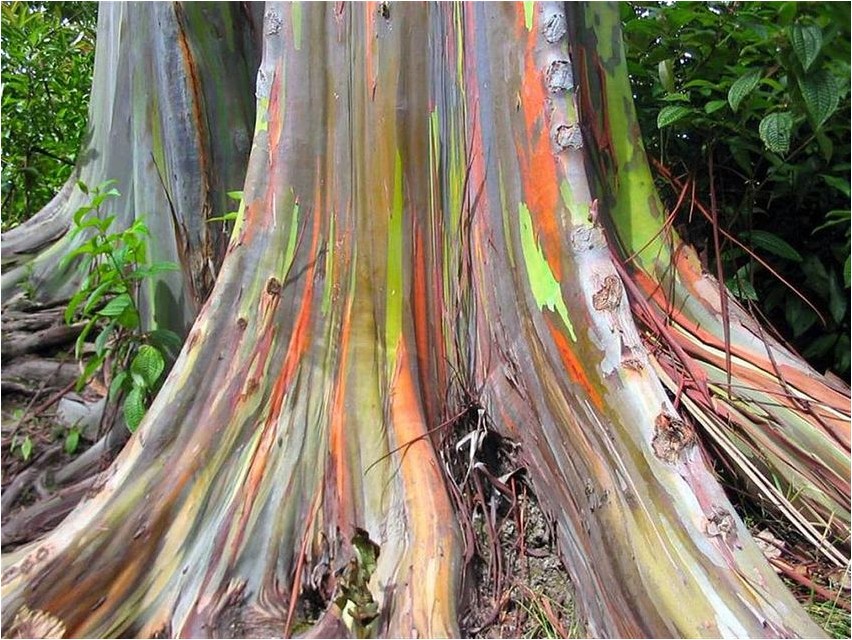
Eucalyptus diversicolor (lat. Eucalyptus diversicolor) is an evergreen, long-lived tree of the genus Eucalyptus (lat. Eucalyptus) from the Myrtaceae family (lat. Myrtaceae).
Eucalyptus versicolor is a landmark of the Australian National Park called Beedelup, located in the western part of the mainland. This is not the only advantage of the plant. Eucalyptus versicolor is also characterized by other qualities for which people love and appreciate plants of the Eucalyptus genus.
What”s in your name
It is clear that the Latin word “Eucalyptus” belongs to the plant by right of its membership in the list of plants of the genus of the same name.
Botanists assigned the specific epithet “diversicolor” (“multi-colored”) to Eucalyptus for the color of its long and narrow leaves, in which the upper side of the leaf plate is dark green, and the lower side is much lighter, which, in general, often happens in nature.
In addition to the official Latin name, the tree has a common, widely known name, the origins of which should be sought in the language of the Australian aborigines, who called Eucalyptus with the word “Karri”.
Moreover, the common name of Eucalyptus multicolored is “Karri” (“Karri”), which should not be confused with another massive Australian tree with a consonant name — “Kauri”.

Description
Eucalyptus versicolor is one of the tallest flowering trees on the planet. Its straight single trunk rushes to the heavens to a height of 80 meters. Since the crown prefers to be located closer to the top of the giant, the wooden boards are long and practically knot-free, which is especially valuable in the construction of roofs. It happens that two closely spaced seedlings grow together, forming a double-trunked tree.
The young bark is white to cream in color, becoming brown and shedding its covering as the tree ages.
The leaves, up to 12 centimeters long and up to 3 centimeters wide, are dark green above and light green below, which gave rise to the species name Eucalyptus.
Inflorescences formed by cream flowers of a characteristic shape for Eucalyptus with fused sepals appear on the branches in spring and summer. Since Curry often grows in poor soils, it has one oddity regarding flowering. Abundant flowering occurs after a forest fire, when tarred Eucalyptus trees continue their lives, taking advantage of the nutrients of the burnt forest floor. To paraphrase a well-known saying, we can say: “If there was no flowering (happiness), but the fire (misfortune) would help.”
The growing season ends with the formation of barrel-shaped, squat fruits, inside of which there are numerous dry small seeds.
Walk through a tree
In western Australia lies Beedelup National Park, which, due to the abundance of moisture in this part of the continent, is characterized by dampness and lush vegetation. The main part of the park”s forest area is made up of Karri trees, that is, Eucalyptus multicolored. The park is famous for many attractions, the main one of which is a beautiful and powerful waterfall.
The second highlight of the park is the Karri Tree Walk. Namely, “through” the tree, since in the powerful trunk of the Karri tree, whose age is estimated at 400 years, a man-made slot was made, starting almost at the base of the tree. The slot is made in the form of an elongated oval, through which a person of average height can easily pass.
Usage
In addition to the fact that the Karri tree is a popular tourist attraction, thereby feeding the tourism industry, Eucalyptus multicolored wood is also used.
By the way, the wood of the tree is also multi-colored. The color of the core of the trunk varies from golden to red-brown, sometimes with a purple or orange tint. So, the species epithet could easily be based on this fact, and not just on the two-colored leaves.
Such beautiful wood makes furniture unique and decorative.