Lepidium campestre
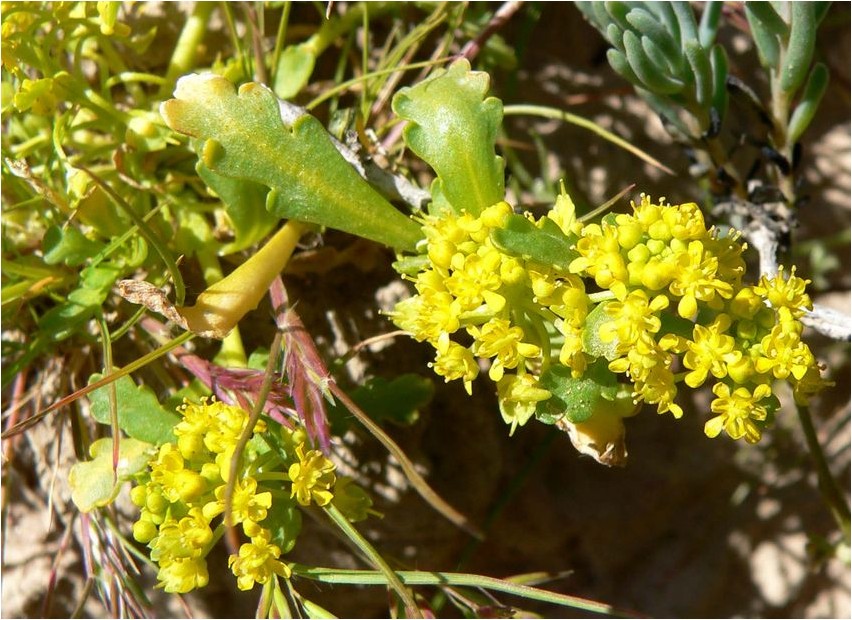
Lepidium campestre is a member of the Brassicaceae or Cruciferae family. Its Latin name is Lepidium campestre (L.) R. Br.
The Latin name of Lepidium campestre is Brassicaceae Burnett or Cruciferae Juss.
Description of Lepidium campestre
Lepidium campestre is an annual or biennial herbaceous plant, reaching a height of between twenty and fifty centimeters. This plant will be softly downy, and rarely, it may be almost completely bare. The stem of Lepidium campestre is solitary and densely foliated, mostly corymbose at the top, and rarely, simple. The basal leaves of Lepidium campestre are oblong and notched-toothed. The flowers of this plant are clustered in a raceme, with white petals approximately two and a half millimeters long. The pods of the field bugleweed are broadly oval, approximately five to seven millimeters long and four to six millimeters wide. The seeds of this plant are ovoid in shape, dark in color, approximately two to two and a half millimeters long and one to one and a half millimeters wide.
The field bugleweed blooms from April to May. In the wild, this plant is found in Crimea, European Russia, Belarus, the Caucasus, and Moldova. It prefers roadside locations, forest edges, forest meadows, crop fields, and pebbly stream beds in the lower and upper mountain zones. It is noteworthy that this plant is a highly valuable honey plant. Description of the medicinal properties of field bugleweed
Field bugleweed has very valuable medicinal properties, and its seeds are recommended for medicinal purposes. These valuable medicinal properties are attributed to the plant’s content of flavonoids, benzyl isothiocyanate, and isothiocyanate. The seeds also contain fatty oil.
It should be noted that the field bug is endowed with very valuable and effective antibacterial properties. As for traditional medicine, a decoction prepared from the seeds of this plant is quite widespread. This decoction based on the seeds of the field bug is used externally in the form of compresses for rheumatism, and this remedy is also used internally as both an antiscorbutic and a carminative.
It is recommended to use the following remedy based on this plant as a carminative: to prepare such a remedy based on field bugs, you will need to take one teaspoon of the seeds of this plant per glass of water. The resulting mixture should be boiled over fairly low heat for four to five minutes, then this mixture is left to infuse for two hours, after which this mixture based on this plant should be filtered very carefully: after this, such a product is completely ready for use. Take this remedy based on bedbugs three times a day, one or two tablespoons. It is very important to remember that in order to ensure the greatest effectiveness when taking such a remedy based on this plant, you should not only strictly follow all the rules for preparing this remedy, but also carefully follow all the rules for its administration. If these conditions are met, the desired positive result will be achieved when taking a remedy based on bedbugs.

How the Klopovnik (Krasnika) berry grows in the forest





