Vigna
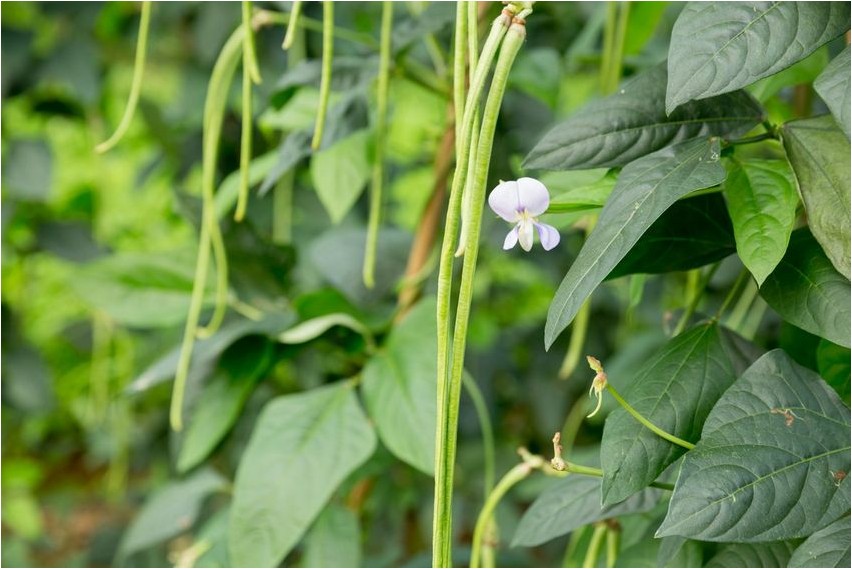
Vigna (lat. Vigna) is a genus of herbaceous plants of the Legume family. The genus has 100 species. The plants are similar in appearance to beans, but differ in the structure of the stipules and gynoecium.
The genus received its name in honor of the Italian scientist and botanist Domenico Vigna, who served as head of the Botanical Garden located in Pisa. Relatively recently, Asian types of beans, more precisely mung bean, adzuki and urd, were assigned to the genus.
Characteristics of culture
Cowpea is a herbaceous plant with erect or creeping stems. Leaves are trifoliate, pinnate. The flowers are yellow, blue, white or purple, collected in racemes. The fruit is a bean, practically no different from the bean fruit, the only difference is the size of the blade (the blade is the flap of the bean with seeds). Sometimes the blade reaches a length of 1 m. In many countries, cowpea is cultivated as a vegetable, fodder, grain and green manure crop. Cowpea is especially popular in China, used as food and as a medicinal plant. Today, asparagus forms of cowpea have been developed and have acquired special significance among Asians.
Species
In central Russia, the ones of greatest interest to gardeners are Japanese cowpea and Chinese cowpea. From one plant, under favorable growing conditions and careful care, you can get up to four kilograms of green beans. Both species are identical in appearance right down to fruit formation. The difference can only be recognized during fruit formation. The flowers of both species are purple and blue, bloom in the early morning, become brownish-yellow in the evening, and then close. When growing several types of cowpea on a plot, it is important to take into account the location, because the crop is self-pollinating, and in order to protect it from cross-pollination, thereby maintaining the purity of the variety, it is advisable to plant the species on different sides of the garden.
Cultivation of Japanese cowpea
Japanese cowpea is currently considered one of the most “difficult” to grow in the climate of Moscow and surrounding regions, since it is a short-day plant and must be cultivated in open ground. Therefore, the climate of the Southern Urals, Khabarovsk region and some Siberian regions is optimal for the species. In the middle zone, Japanese cowpea begins to bear fruit in August — early September. To obtain an early harvest, the crop is grown in greenhouses. The approximate growing season is 120-150 days; it is difficult to name the exact period from sowing to ripening.
Cultivation of cowpea
Chinese cowpea, unlike Japanese cowpea, is less whimsical. The growing season is from 60 to 90 days. The area for the crop is prepared in the fall: the soil is dug up with a shovel full, rotted manure and superphosphate are carried. In the spring, the ridges are loosened and fed with potassium and nitrogen fertilizers. Agronomists claim that cowpea provides 50-60% of its nitrogen fertilizers due to the absorption of free nitrogen by the root system, but in practice everything is not so smooth. Due to a lack of nitrogen, plants begin to turn yellow prematurely, growth stops, and the beans ripen prematurely and become smaller. Seeds are sown in mid-to-late May using a three-line or ribbon method. The seeding depth is 4-5 cm. The distance between lines is 25-30 cm, between tapes is 45-50 cm, between plants is 10-12 cm. For the first time, the crops are covered with film, regularly moistened and ventilated.

Care
Almost all types of cowpeas need support. The supports are installed along the lines. It is important to take into account the fact that plants form a powerful green mass during the growth process, so the supports must be very strong. Throughout the growing season, cowpea needs regular weeding, loosening the soil between rows and watering. Fertilizing is carried out twice: the first — during sowing, the second — during fruit formation. The fruits are collected 10-12 days after the ovaries appear. If you harvest regularly, the plants will more actively form new fruits.