Swamp geranium
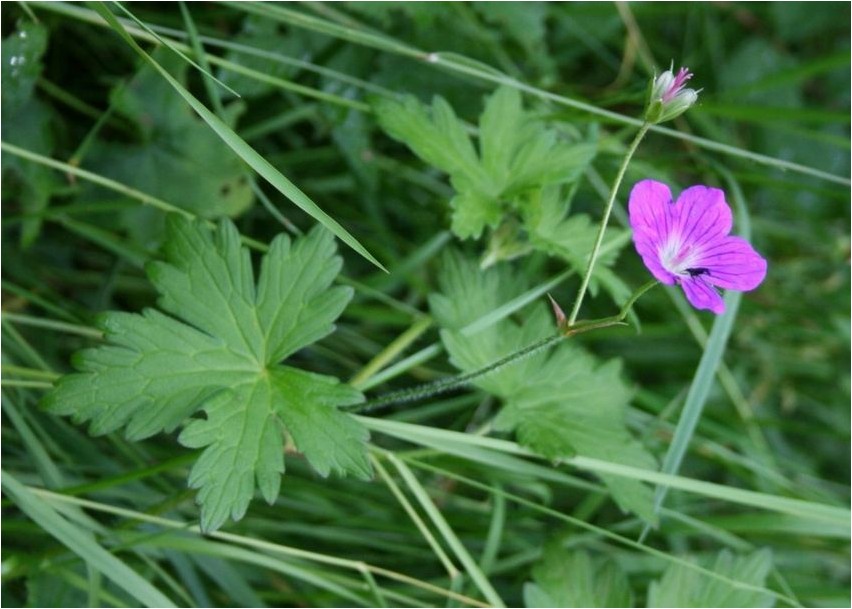
Marsh geranium is one of the plants of the family called Geraniaceae; in Latin the name of this plant will be as follows: Geranium palustre L.
As for the name of the marsh geranium family itself, in Latin it will be: Geraniaceae Juss.
Description of marsh geranium
Swamp geranium is a perennial herbaceous plant whose height will be about thirty to seventy centimeters. The rhizome of this plant is ascending, and is also covered with the remains of stipules from the basal leaves; in addition, such a rhizome will develop one or three more stems, as well as quite numerous leaves. However, such leaves die very early. The basal leaves of this plant are on long hairy petioles, the length of which can reach up to twenty centimeters. The stem leaves of marsh geranium are five-lobed, and the upper leaves will be almost sessile and tripartite. It is noteworthy that the inflorescences of this plant will be much longer than the adjacent leaves, and the length of the peduncles will be approximately five to ten centimeters. Such peduncles will contain approximately two flowers, the length of which will be five to seven centimeters; it should be noted that such flowers are large, and their diameter is about three centimeters. The petals of marsh geranium will be obovate and purple in color, at the top they are whole, and their length is one and a half centimeters, while the petals are twice as long as the sepals themselves.
Swamp geranium blooms from June to around July. The fruits of this plant ripen in August-September. Under natural conditions, marsh geranium can be found in Ukraine, Belarus, the Caucasus, and also in the European part of Russia. For growth, this plant prefers forest edges, valleys, wet meadows, grassy swamps, and marsh geranium can also be found among shrubs up to the upper mountain zone.
Description of the medicinal properties of marsh geranium
Swamp geranium is endowed with quite valuable healing properties, and the roots and grass of this plant are used for medicinal purposes. The term herb includes the leaves, flowers and stems of marsh geranium. Such raw materials should be harvested while this plant is in flowering.
Such valuable medicinal properties are explained by the content in the roots of this plant of starch, steroids, triterpenes, catechins, tannins, as well as sucrose, glucose and the following phenols: pyrogallol, resorcinol, pyrocatechol. In addition, the roots of marsh geranium also contain derivatives of phenolcarboxylic acids. At the same time, the grass of this plant will contain flavonoids, tannins and the following carbohydrates: fructose, raffinose, glucose and sucrose. Moreover, the leaves of this plant contain quinones, tannins, vitamin C, as well as flavonoids in the hydrolyzate quercetin and kaempferol. As for the flowers of marsh geranium, they contain vitamin C.

The experiment proved that an infusion of the herb of this plant can cause a decrease in heart rate. An infusion, as well as a decoction, prepared from the marsh geranium herb, is recommended to be taken orally for a variety of colic, as well as pain in the ears and even with a sharp weakening of hearing. As for traditional medicine, an infusion of the herb of this plant is used as an astringent and hemostatic agent, as well as for rheumatism, gout, dysentery and kidney stones.
For dysentery, rheumatism, gout and kidney stones, the following remedy is recommended: to prepare it, take fifteen grams of marsh geranium herb per glass of water. The resulting mixture is boiled for three minutes, then infused and filtered thoroughly. This remedy is taken three times a day, half a glass.





