Licorice bristlecone
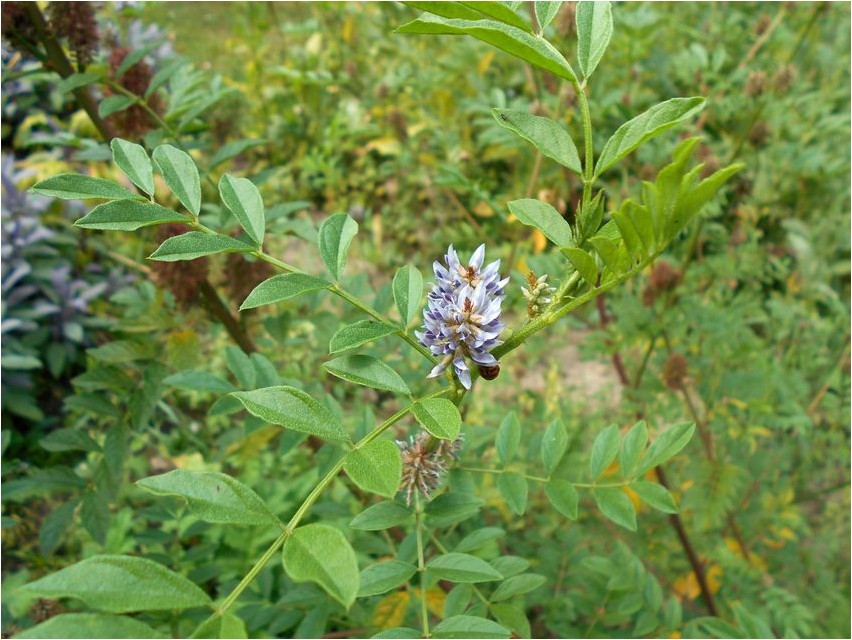
Licorice bristlecone is one of the plants of the family called legumes; in Latin the name of this plant will be as follows: Glycyrrhiza echinata L.
As for the name of the bristly licorice family itself, in Latin it will be like this: Fabaceae Lindl. (Leguminosae Juss.).
Description of licorice bristlecone
Licorice bristlecone is a perennial herbaceous plant with spreading or erect stems. The height of such a plant will fluctuate between fifty and one hundred and thirty centimeters. The leaves of Licorice bristlecone are petiolate and they are endowed with three to six pairs of leaflets. Such leaflets, in turn, will be either obovate or elliptical in shape; at the very base they are narrowed, and at the apex they are most often endowed with a short pointed tip; the length of the leaflets will not exceed forty-five millimeters. The bracts of this plant will be lanceolate and fall off early. The inflorescence itself is almost spherical, thick and capitate. The length of licorice bristlecone flowers reaches ten millimeters, they will be almost sessile and colored in violet-blue tones. The calyx, in turn, is endowed with rather wide teeth, and the beans will be closely crowded, elliptical or ovoid in shape, they are in dense spherical heads, densely seated in the upper part by means of spines, and the length of such beans will not exceed sixteen millimeters.
Licorice bristles blooms in the second half of the summer. Under natural conditions, this plant is found in the Crimea, the Caucasus, Moldova, the Dnieper region and the Carpathians in Ukraine, the Verkhnetobolsky region of Western Siberia, as well as the following regions of the European part of Russia: Lower Volga, Black Sea, Zavolzhsky, Lower Don and Verkhnedon. For growth, bristle licorice prefers meadows, river and stream valleys, the banks of ditches, oxbow lakes and lakes, as well as the edges of fields.
Description of the medicinal properties of licorice bristlecone
Licorice bristlecone is endowed with very valuable healing properties, and it is recommended to use the roots and herbs of this plant for medicinal purposes. The term grass includes flowers, stems and leaves. The presence of such valuable healing properties should be explained by the content of carbohydrates and related compounds in the roots of this plant: pectins, mannitol, sucrose, glucose, starch, spol, pterocarpans medicarpine, flavonoids vestol, liquiritin and liquiritenin, nitrogen-containing compounds, organic acids tartaric, malic, succinic, fumaric, oxalic and citric, triterpenoids in hydrolyzate of isoquinic, equinatic, isomacedonic and macedonic acids.
Actually, it should be noted that the roots of licorice bristlecone have been used in a similar way to the roots of licorice glabra. Such medicinal agents are used as expectorants and enveloping agents for various respiratory diseases. A decoction prepared from the roots of Licorice bristles is indicated for use in bladder cancer. In China, the root powder of this plant is used for carcinomatous wounds. It is noteworthy that during the experiment it was proven that the root extract of this plant has the ability to exhibit antifungal and antitumor activity, and the phenolic fraction will also exhibit antibacterial activity.

In Crimea, infusions and decoctions prepared from the aerial parts of Licorice bristles are used for dermatoses. A decoction based on the seeds of this plant is indicated for use in gastrointestinal colic. In addition, the roots of licorice bristlecone have the ability to color fabrics in red-brown and dirty yellow tones.





