Svidina
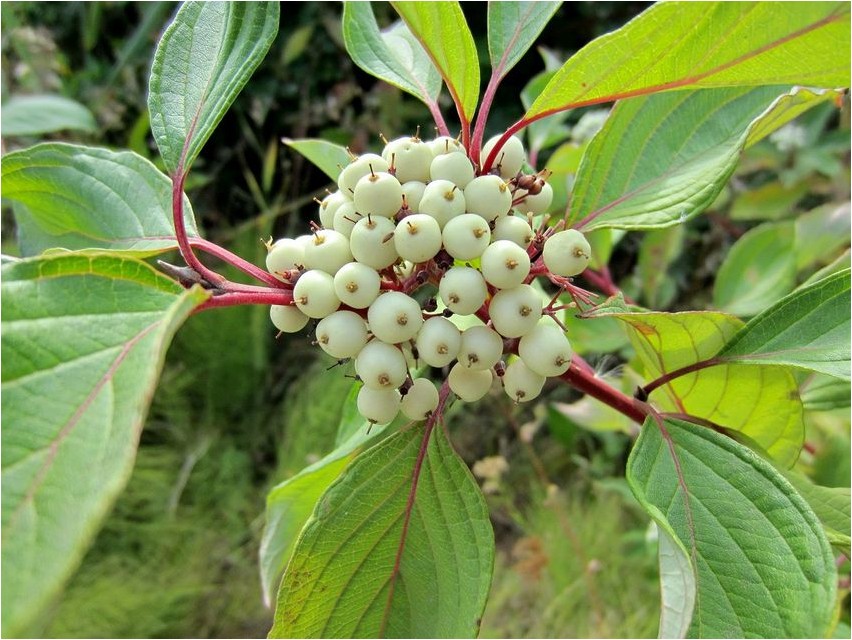
Svidina (lat. Cornus) is a light-loving woody plant belonging to the Dogwood family. Other names are derain, dogwood or cornus.
Description
Svidina is an incredibly attractive deciduous shrub, equipped with entire leaves and small flowers collected in fancy inflorescences.
The flowers of the svidina are white or golden-yellow, and closer to autumn, small drupes ripen on the trees, which can be colored either white or blue.
With the onset of autumn, the leaves of the svidina turn into amazing burgundy or pink tones. In total, the genus of swine has about fifty species.
Where does it grow
Temperate regions of the Northern Hemisphere — this is what the majority of the swine”s distribution area looks like. However, some species of this plant can be found in South America, as well as in Central Africa.
Usage
Svidina is actively used in ornamental gardening, and in this case, mainly the following three types are used: red svidina, white svidina and scion svidina. Svidina is especially often planted as hedges; in addition, this plant looks great as part of a wide variety of compositions.

Hoops are made from thin branches of svidina and baskets are woven. The leaves and seeds of some of its varieties are excellent substitutes for coffee and tea, and the fruits are used to treat stomach diseases.
Growing and care
Svidina will feel best in sunny or semi-shaded areas (this is especially true for variegated varieties), and it can be planted on absolutely any garden soil. In general, swine is undemanding in terms of soil composition, but slightly acidified substrates are still considered the most preferable for its cultivation. In the case of this plant, experts recommend deep planting; in addition, before planting the pig, it is advisable to generously season the planting holes with humus.
It is completely undemanding in care, and what is especially pleasant is that it boasts quite impressive winter hardiness. This plant is watered mainly when drought is established, and with the onset of spring it is recommended to feed it well with some complete mineral fertilizer.
If the svidina is grown for its branches, which are especially beautiful in winter, then in early spring it is necessary to prune them, completely removing the shoots located at a height of five to twenty centimeters from the ground. And if this plant is planted for the sake of beautiful foliage and flowers, then pruning need not be carried out — it is enough to simply thin out the tree crowns every few years (usually this is also done in early spring, before the buds bloom).
Svidina can be propagated by seeds, root suckers or cuttings. Most often, its propagation is carried out precisely by cuttings, that is, vegetatively: in the spring it is propagated by lignified or root cuttings, and in the first half of June — by green cuttings (this option is considered the best). Initially, the cuttings are planted in cold greenhouses, and by autumn they can boast of a fairly powerful root system. For the winter, the grown cuttings are transferred either to heated greenhouses or to basements, and with the onset of spring they can be planted outside.
Svidina usually does not attract pests, and it is practically not susceptible to disease. True, occasionally young shoots of this plant can still be affected by fungal diseases or aphids.





