Shieldweed
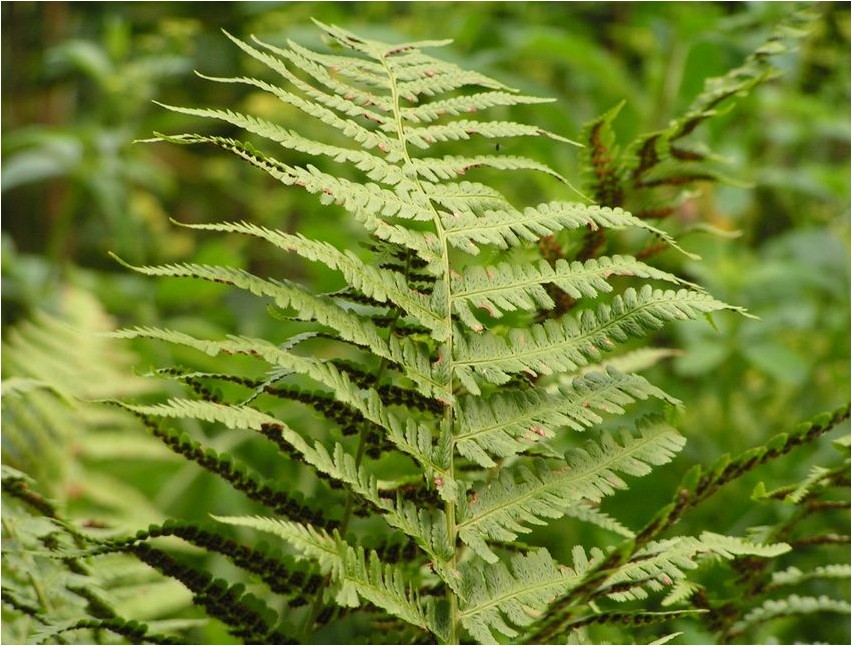
Shield plant (lat. Dryopteris) is a large genus of herbaceous plants of the Shield family. One of the most common ferns in the world and the temperate climate zone.
Includes over 150 species. Found in forests, including oak. On the territory of Russia, you can capture about 20 species of shieldweed. Almost all representatives of the genus have a unique composition; they contain anthocyanins, phenolic compounds, vitamins (especially many B vitamins), tannins and higher fatty acids. For this reason, plants are actively used in folk medicine.
Interesting fact
There are many popular beliefs and superstitions associated with ferns. The shieldweed is no exception. There is a legend about the fiery flower of the male shield plant. A hundred years ago it was believed that a person who discovered a rare flower on the night of Midsummer Day would be gifted with the ability to foresee the future. In addition, he becomes a powerful, rich and happy person. There is a superstition that he, as it were, enters into an alliance with dark forces.
Characteristics of culture
The shield plant is represented by perennial herbaceous plants no more than 1. 5 m high. They are characterized by thickened straight or creeping rhizomes, which are covered over the entire surface with scales, sometimes with stiff hairs. The foliage is large, most often double pinnate, collected in a lush rosette. The fronds are elongated, lanceolate, dissected, connected into funnel-shaped bunches. The leaf petioles are relatively thick, shortened, and covered with brown or brown scales. The sori are round and formed on the veins. The veil is thyroid or rounded.
Known species Austrian shieldweed (lat. Dryopteris austriaca) is a native of the Caucasus. It can also be found in nature in the Primorsky Territory and the USA. Typical places of growth are forest zones, damp areas, including swamps, banks of rivers and lakes. It is used for medical purposes to obtain an extract that is effective against worms. The species is represented by pinnate, deltoid foliage with lanceolate segments of the first order, pinnate segments of the second order, serrated segments of the third order and, finally, yellowish petioles.
The Austrian shield fern has a subspecies, subsp. Spinulosa. It is characterized by plants with bare, ovate, short-pointed foliage, no more than 100 cm long. These foliage is yellowish-green, lacks obvious glands, and has a fragile petiole, completely covered with brown films that fall off over time. This subspecies is widely cultivated. It is used for decorating and landscaping shady and damp areas of the garden.

Another interesting member of the genus is the fragrant shield fern (Dryopteris fragrans). It can be found throughout almost all of Russia, as well as in China and Korea. This member of the genus is also a frequent visitor to the United States. It prefers mountain slopes and forests. The plant is characterized by its low growth (up to 30 cm maximum) and blue-green, linear or lanceolate foliage with a distinct but very pleasant scent. The foliage, incidentally, has prominent veins and a petiole covered with brownish films.
Bush’s shield fern (Latin: Dryopteris buschiana) is found primarily in China, Korea, Japan, and Sakhalin. Typical habitats include coniferous and mixed forests, as well as damp areas. The species consists of large plants crowned with glossy, lanceolate foliage, gathered into a lush rosette. The rosette is very reminiscent of a cup. Bush’s shield fern does not exceed 100 cm in height, although smaller specimens are also found, largely depending on climatic conditions, especially humidity.
Another species of fern is the crested shield fern (Latin: Dryopteris cristata). It grows primarily in European countries, the United States, and Siberia. It is most often found in swamps and damp and humid forests. The species is represented by low-growing plants with thick rhizomes and dark green, glabrous, leathery, shiny, petiolate, pinnately dissected foliage, the segments of which are long lanceolate and short elongated.





