Kermek broadleaf
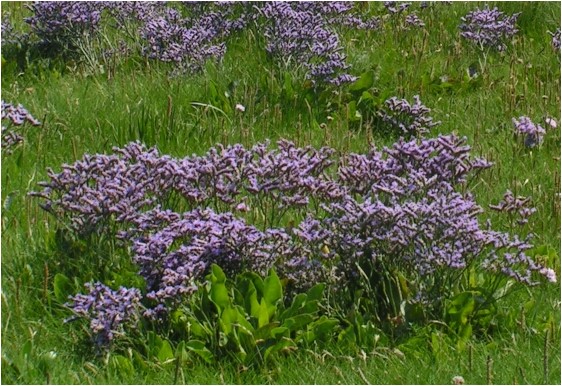
Kermek broadleaf is one of the plants of the family called leadaceae; in Latin the name of this plant will be as follows: Limonium platyphyllum Kuntze (L. latifolium statice coriaria Pall.).
As for the name of the broad-leaved Kermek family itself, in Latin it will be like this: Plumbaginaceae Juss.
Description of broadleaf kermek
Kermek broadleaf is a perennial herbaceous plant, the height of which will be about forty to one hundred centimeters. The stem of this plant is straight, and at the top it will be highly branched. All leaves of Kermek broadleaf will be basal, they are oblong-elliptical in shape, their length will reach thirty centimeters. Gradually, such leaves will narrow into a rather long petiole, like the stem itself. Such leaves are also densely pubescent with small tufted hairs. The inflorescence of this plant will be very large and loosely paniculate, almost spherical. The inflorescence of Kermek broadleaf will consist of one or two flowering spikelets arranged. The bracts of this plant are broadly membranous. The flowers of this plant are five-membered, and the calyx is endowed with a white limb. The corolla of broadleaf kermek is painted in purple tones. The fruit of this plant is an achene that will be enveloped in a calyx. Under natural conditions, this plant is found in the south of Ukraine, Crimea, Moldova, the Caucasus, and also in the south of the European part of Russia. It should be noted that this plant will grow singly or in small groups in meadows, steppes, on dry rocky slopes and in river valleys. It is noteworthy that broadleaf kermek is an ornamental plant.
Description of the medicinal properties of Kermek broadleaf
Kermek broadleaf is endowed with very valuable healing properties, and it is recommended to use the roots of this plant for medicinal purposes. The presence of such valuable healing properties is explained by the content of catechins in the plant. The roots of this plant contain tannins, dyes, ellagic acid, phenolcarboxylic and gallic acid. The anthocyanins delphinidin and cyanidin were found in the aerial part of the broadleaf kermek, and quercetin, delphinidin and myricetin were present in the leaves. The petals of this plant also contain anthocyanins.
The plant is endowed with hemostatic, astringent, anti-inflammatory, analgesic and wound-healing effects.
A fine powder or decoction prepared from the roots of this plant is used for hemorrhoids, dysentery, diarrhea, internal bleeding, gynecological diseases, inflammation of the oral cavity and uterus, malaria and chronic hemoptysis. As for external use, this remedy is used as a wound healing agent and will also cure gangrene and eczema. An infusion of the roots of Kermek broadleaf, along with other plants, is recommended for use for stomach ulcers.

As for veterinary medicine, Kermek broadleaf is used to treat horse sores. The root of this plant is an excellent natural tanning agent, which is used in tanning morocco. This plant can be used to tan fishing gear. Leather that has been tanned with this plant will be colored brown, pinkish and greenish.
For uterine fibroids, it is recommended to use the following remedy, for the preparation of which you will need to take forty grams of the roots of this plant per five hundred milliliters of water. This mixture is boiled for seven minutes, then infused for two hours and filtered thoroughly. Take this remedy half a glass or one third of it three to four times a day before meals.





