Lovage
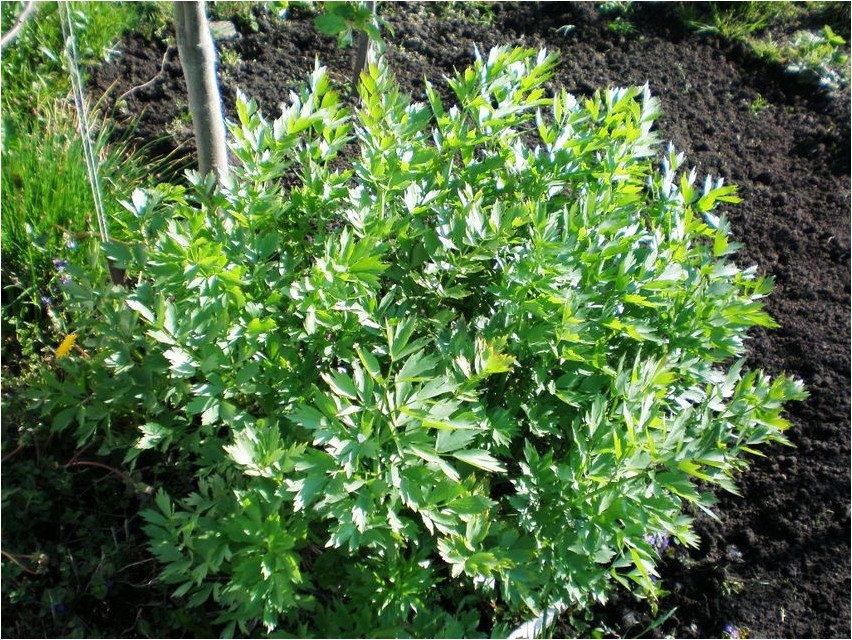
Lovage (lat. Levisticum) is a monotypic genus of perennial herbaceous plants of the Apiaceae family. The only species is Lovage (lat. Levisticum officinale).
Popular names are libistik, zorya, lyub, love potion, lyubchik, lyubets, love potion and lyub-grass. Natural range: Afghanistan and Iran. Currently, lovage is cultivated in many countries around the world.
Characteristics of culture
Lovage is a herbaceous plant with external characteristics similar to celery. The root system is powerful, fibrous, the main part of the roots lies at a depth of 30-40 cm. The stem is hollow, strong, bluish, 2-2. 5 m high. The leaves are bare with a glossy sheen, twice or thrice pinnately dissected, the lobes are large, rhombic or obovate. The basal leaves are long-petiolate. The flowers are small, white-yellow in color, collected in complex radiant umbrellas. The fruit is an elliptical two-seeded yellow-brown color that, when ripe, is divided into two halves.
The culture develops in a two-year cycle: in the first year of life, the plants form a rosette with seven to nine leaves up to 50 cm long; in the second year, flower stalks and, accordingly, fruits and seeds appear. Lovage blooms in June-July. Flowering lasts about 20-30 days. The culture can grow in the same place for up to 15 years. Lovage is a frost-resistant plant that easily tolerates winters in open ground. Seeds germinate at a temperature of 3-4C. The optimal growing temperature is 18-20C. Seedlings tolerate frosts down t o-5C without problems, adult plants – down t o-8C. Higher temperatures have a detrimental effect on plant development. The culture is valued for its high content of vitamins, essential oils and mineral salts.
Growing conditions
Lovage prefers sandy, clay or peaty, breathable, moderately moist and nutritious soils. The crop does not accept an excess of nitrogen fertilizers; in this case, the root becomes too voluminous and eventually loses its juiciness and density, and darkens when cooked. Sites for growing lovage should preferably be well lit; light openwork shade is not forbidden. The culture is negative for waterlogged, saline, waterlogged and acidic soils.
Soil preparation and sowing
The area for lovage is prepared in the fall: the soil is dug up, compost (4-5 kg per 1 sq. m), urea (15-20 g), superphosphate (20 g), potassium sulfate (30 g) and wood ash (30 g) are added. In the spring, if necessary, fertilize with fertilizers with a high content of microelements. Seeds are sown early; winter sowing can also be done.

Most gardeners grow lovage using seedlings; it is the most promising. The crops are covered with film and placed in a room with an air temperature of 20-22C. A couple of weeks after emergence, the seedlings are fed with potassium chloride, ammonium nitrate and superphosphate. After another two weeks, re-feeding is carried out. Seedlings are planted in open ground after 45-50 days.
When sowing crops directly into open ground, maintain a distance between rows of 70-75 cm. The first thinning is carried out when 2-3 true leaves appear on the seedlings, and the next – after 30-35 days. The final interval between plants should be at least 50 cm, this is quite enough for full development and long-term cultivation. The same scheme is acceptable for seedlings.
Care
Caring for lovage consists of weeding, loosening, watering and fertilizing. Watering is carried out as needed; the soil in the near-stem zone should not be allowed to dry out. If primary feeding is carried out in early spring, then secondary feeding is carried out in mid-summer. When growing a crop for greens, and not for seeds, the emerging flower stalks are broken off when they reach a height of 10 cm.
When harvesting, cutting should not be done too thoroughly; this will subsequently affect the growth of the roots. Only one copy will be enough for seeds. Lovage is very rarely affected by diseases and pests, which is due to the presence of essential oils in all green parts of the plant.
Application
Lovage is widely used in cooking and perfumery, as well as in folk medicine. Fresh leaves, stems and roots are used to flavor drinks, confectionery, baked goods and marinades. Lovage is often included in green oils, salads, sauces and gravies. As a spice, the plant is added to soups, rice dishes, poultry, vegetables and fish.
Lovage is of particular importance in dietary nutrition. The plant is used in the treatment of diseases of the liver, kidneys, gall bladder, rheumatism, obesity and flatulence. Lovage is useful for heart disease, pyelonephritis, edema, urinary retention, anemia, algomenorrhea, migraine and gout. Lovage is contraindicated for pregnant women.





