Euphorbia sungazer
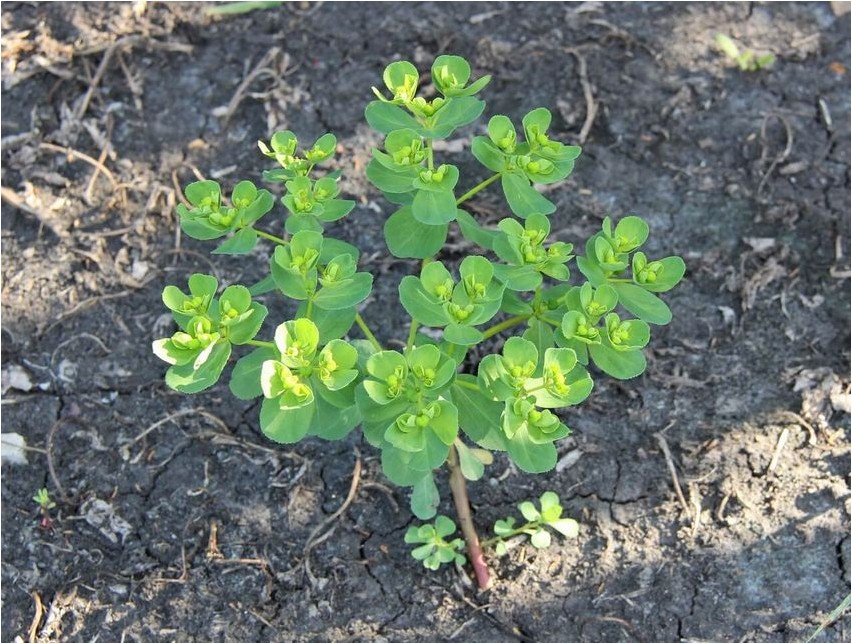
Euphorbia sungazer is one of the plants of the family called Euphorbiaceae; in Latin the name of this plant will be as follows: Euphorbia helioscopia L.
As for the name of the milkweed sungazer family itself, in Latin it will be: Euphorbiaceae Juss.
Description of milkweed sungazer
Euphorbia sungazer is an annual herbaceous plant whose height will vary between ten and fifty centimeters. Such a plant is sparsely hairy, especially at the top, but it can also be naked. The root of Euphorbia sungazer is spindle-shaped and thin. The stems on the roots range from one to thirty, their thickness will be about one to four millimeters, they can be either spreading or erect.
The stem leaves of this plant are short-petiolate and alternate, they can be either spatulate or obovate, their length is eight to twenty-eight millimeters, and their width is about five to thirteen millimeters. There will be only five apical peduncles of the milkweed sungazer, their length will be from half a centimeter to four centimeters, and at the end such peduncles are tripartite. The glass of this plant is bell-shaped, its diameter will be about one and a half to two and a half centimeters, such a glass will be bare on the outside, and slightly fluffy on the inside. The milkweed sungazer seed is brown in color and will be ovoid.
This plant blooms from April to May. Under natural conditions, this plant is found in the Caucasus, Central Asia, Moldova, Belarus, Ukraine, the southern part of Scandinavia, Central Europe, India, Pakistan, Japan, Iran, Armenia, the Balkan Peninsula, as well as in all regions of the European part of Russia, with the exception of the Zavolzhsky, Dvina-Pechora and Karelo-Murmansk regions. For growth, this plant prefers vegetable gardens, fallow lands, garbage areas, ditches, roadsides and sometimes crops. It is noteworthy that this plant is poisonous, and its milky juice can cause abscesses on the skin and affect the mucous membranes of the gastrointestinal tract, nasal cavity and eyes.
Description of the medicinal properties of milkweed sungazer
Euphorbia solnax possesses valuable medicinal properties. It is recommended to use the plant’s herb, milky sap, resin, and roots for medicinal purposes. The herb includes the flowers, leaves, and stems. It is recommended to harvest this raw material in the spring and summer. To do this, you need to cut the herb, dry it, and chop it.

The plant’s valuable medicinal properties are explained by its content of diterpenoids, fructose, maltose, succinic acid, glucose, rubber, steroids, flavonoids, and phenolic acids. The milky sap contains steroids, while the roots contain quercetin, quercitrin, and resins.
Euphorbia solnax possesses highly effective bactericidal, anti-inflammatory, expectorant, anthelmintic, emetic, laxative, and analgesic properties. An infusion made from the herb of this plant is recommended as an antitumor agent, while a decoction is applied externally for furunculosis.
In folk medicine, a decoction of the herb of Euphorbia solntspeja is widely used for rheumatism, anthrax, malignant tumors, and as a powerful stimulant. A decoction made from the aerial parts of this plant is recommended for syphilis.