Sea buckthorn
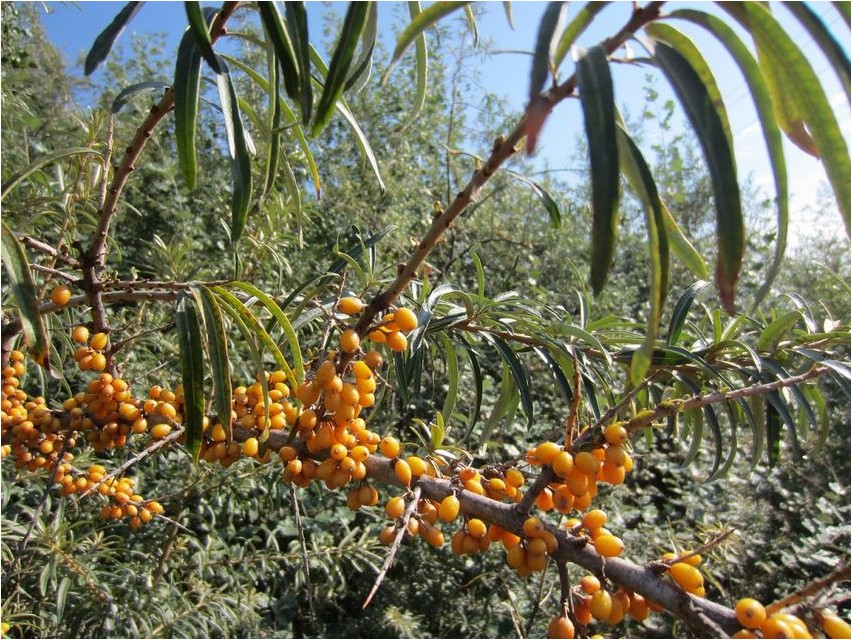
Sea buckthorn (lat. Hippophae) is a berry crop; shrub of the Sucker family. Under natural conditions, sea buckthorn grows in Siberia, the Urals, Asia, Western Europe and the Caucasus.
Description
Sea buckthorn is represented by spreading thorny bushes or small trees, reaching a height of up to 6-7 m. The root system of sea buckthorn is quite powerful; small tubers are formed on individual roots; they contain microorganisms that absorb natural nitrogen. Young shoots of the crop in question are silver-gray in color, pubescent with short hairs, and perennial branches are brown. The leaves are lanceolate, elongated, green with a bluish bloom or rusty-golden, sometimes have small black dots on the surface, reaching 5-8 cm in length and 0. 5-1 cm in width.
The flowers are light yellow, small, crowded or collected in short spike-shaped inflorescences, located at the base of young shoots or in the axils of the covering scales. The perianth of the flowers is simple, cup-shaped, bifid. Flowers appear before leaves. Sea buckthorn blooms in the third ten days of April — the first ten days of May.
The fruits are false drupes, can be orange or reddish in color, spherical or oval in shape, with a diameter of no more than 0. 5 cm. The crop produces abundant fruit, the berries are densely located on the surface of the shoots, and do not fall off for a long time. The lifespan of shrubs is 50-70 years, but in the 25th year of cultivation, the yield decreases significantly. Today, there are varieties of sea buckthorn whose shoots do not bear thorns.
Growing conditions
Sea buckthorn is a plant that is not demanding in terms of growing conditions, but grows well in light, loose soils enriched with minerals. In areas with poor and dry soils it produces yields of small berries. Sea buckthorn is moisture-loving; close groundwater is not a hindrance for it. Does not grow well in shaded areas and loves sunlight.
Reproduction and planting
Most often the crop is propagated by cuttings. Cuttings are taken from plants over 7 years old. Cuttings are carried out in early spring before the buds swell. Planting material is planted in greenhouses under film until rooting. Young plants are transplanted to a permanent place after 2 years. Less commonly, the crop is propagated by seeds, although the varietal characteristics of the mother plant are not always inherited.

It is advisable to plant female and male plants on the site, since the crop is pollinated by the wind. The optimal distance between bushes is 4-5 m.
Planting is carried out in early spring, depending on the region — in the third ten days of April — the first ten days of May. Autumn planting is not prohibited, but seedlings do not always have time to take root and die from frost. Planting holes are prepared in a couple of weeks, the depth of the hole is about 50-60 cm, and the width is 50 cm. One third of the hole is filled with a nutrient substrate, and potassium and phosphorus fertilizers are added. It is not recommended to add nitrogen, otherwise burns to the root system will not be avoided.
The roots of seedlings should not be trimmed; it is necessary to slightly shorten too long roots and remove damaged ones. The seedling is lowered into the planting hole, sprinkled with a nutrient mixture, thoroughly compacted, watered abundantly and mulched with peat. The neck of the seedling is deepened by 4-6 cm, this approach promotes the formation of new roots. It is advisable to tie young bushes to stakes.
Care procedures
To obtain a good and tasty harvest of berries, sea buckthorn requires careful and timely care, which consists of watering, weeding and loosening. Since the roots of the shrubs are shallow, it is impossible to dig up the soil in the tree trunk area. Loosening is carried out to a depth of 5-7 cm.
In the absence of winds during flowering, it is necessary to carry out pollination yourself by cutting off the flowering shoot of the male specimen and attaching it to the female. Sea buckthorn requires regular sanitary pruning; this procedure is carried out in early spring before sap flow begins; broken, frozen and diseased branches are removed from the bushes.
To avoid damage to sea buckthorn by various diseases, plants are periodically treated with a 1% solution of Bordeaux mixture. Feeding is carried out once per season. Compost, potassium chloride and superphosphate are perfect for this purpose.





