Tlandianta
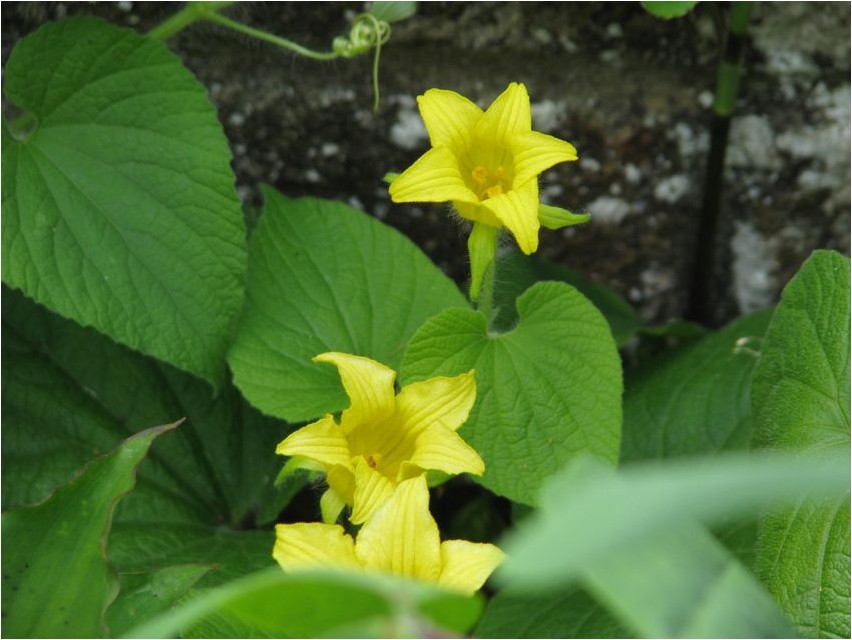
Tlandiantha, or perennial cucumber (lat. Thladiantha) is a perennial herbaceous plant of the Cucurbitaceae family. Tlandianta is cultivated for decorative purposes in Northeast China and the Far East.
The crop is grown in small quantities in Europe, the USA and Canada. In central Russia, the plant is a rare guest.
Characteristics of culture
Tlandiantha is a climbing dioecious vine with stems covered with protruding hairs and entire leaves with tomentose pubescence. The fruits resemble small cucumbers in shape and size, which acquire a red tint towards the end of the growing season. The pulp of the fruit is very tender and sweet. The fruit contains 40-100 dark seeds with a hard skin.
Tlandianta flowers are pollinated by wild bees belonging to the genus Ctenoplectra. In the evening, insects land on the opening male flower bud, and in the morning they leave it, transferring pollen to the female flower. Domestic bees do not notice tlandianta flowers and pollinate them extremely rarely. This is probably why tlandianta is propagated mainly by vegetative methods rather than by seeds, although this statement has not been confirmed by anything.
A distinctive feature of the plant is the presence of a chain of tubers on underground and aboveground shoots located in close proximity to the soil surface. In the spring, new shoots form from each tuber, and nodules connected in the form of a chain form underground. Thanks to this, over the course of several years of life, plants grow quite large masses and occupy large areas. This condition should be remembered when growing vegetable crops next to tlandianta.
Many gardeners talk about tlandiant as a highly decorative and unusual plant. The plants” vines are thin and long, highly branched, and often climb to the tops of fruit trees. In the conditions of the Moscow region and nearby areas, seedless fruits are formed, up to 8 cm long.

Growing conditions
It is recommended to grow tlandianta on well-moistened, loose, non-saline soils with a high humus content and a neutral or slightly acidic pH. Optimal peat soils. The culture is negatively related to waterlogged, heavy and highly acidic soils. The latter require preliminary liming.
On fertile and fertilized soils, plants form a larger number of healthy and large tubers than on thin clays. It is not forbidden to grow the crop on a windowsill or on a balcony; it does not require special care, so it will not cause much trouble to its owner, but, on the contrary, will delight him with its beauty.
Growing
Tlandiantha is propagated by nodules, cuttings and seeds. The latter method is rarely used in the middle zone. The tubers from which new plants are formed are severely depleted and die by autumn, while new ones continue to develop and produce new shoots in the spring.
To decorate gazebos and other buildings, as well as to create hedges, tubers are planted in one row with an interval of 90-100 cm. Tlandiantha is characterized by increased shade tolerance and cold resistance; adult plants can withstand frosts down t o-3C. Frostbitten shoots quickly recover from dormant tuber buds. The crop is rarely affected by diseases and pests.