Vodjanika
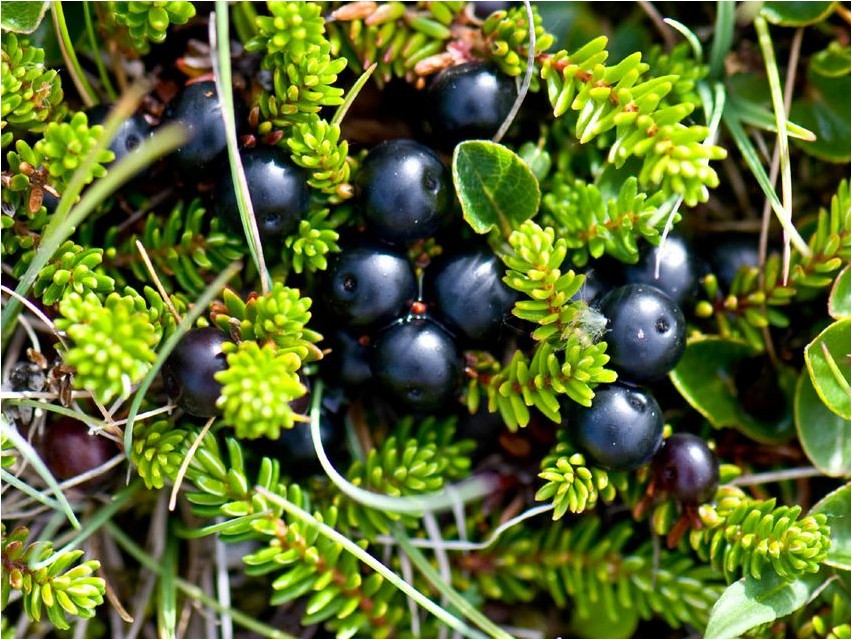
Crowberry (lat. Empetrum) is a genus of evergreen creeping subshrubs and shrubs of the Ericaceae family. The plant is also known under the names bagnovka, shiksha, crowberry, bearberry, pork blueberry and black grass.
All existing species have edible fruits, but only one species is cultivated — black crowberry.
Distribution
In nature, crowberry is found in temperate climates and the subarctic zone (Russia, Finland, Spain, Iceland, Great Britain, Greenland, Canada, USA, Japan, China, Korea, Mongolia). Some species are native to the Chilean Andes, the Malvinas Islands, Tristan da Cunha and Tierra del Fuego.
In Russia, the culture has become widespread in the northern regions: Siberia, the Far East, Sakhalin, Kamchatka and the Kuril Islands. Typical habitats of wild crowberry varieties are rocky and moss-lichen tundras, coniferous forests, sphagnum bogs, open sands, dunes, granite outcrops and mountains.
Characteristics of culture
Crowberry is a low-growing creeping subshrub or shrub 20-30 cm high, growing in clumps. The stem is heavily leafy, branched, dark brown in color. When young, the stem is covered with brown hairs over its entire surface.
Curtains grow quickly, while forming adventitious roots. The central branches die off over time. The crowberry branches are hidden in a moss “cushion”, equipped with pinpoint glands of amber or white color, and reach a length of 50-100 cm.

The leaves are small, short-petioled, narrowly elliptical in shape, 3-10 mm long. The edges of the leaves are closed or curved down, the leaves look like needles, and the shrub itself resembles a dwarf spruce. The flowers are inconspicuous, axillary, equipped with an actinomorphic perianth with three sepals and three petals of red, pink or purple color. In the European part of Russia, crowberry blooms in April-May, in Siberia — in May-June.
The fruit is a red or black berry with a tough skin and hard seeds. Externally, the fruits are similar to blueberries. The fruits ripen in August-September (depending on climatic conditions) and remain on the branches until next spring.
Growing conditions
Crowberry prefers peaty and acidic sandy soils with good drainage. It is negative for compacted, heavy clay and waterlogged soils. The culture is favorable to sunny areas, although it develops no worse in partial shade. Some varieties accept full shade, and this is understandable, because crowberry’s natural habitat is coniferous forests and tundra.
Propagation and Planting
Crowberries are propagated by seeds, cuttings, and layering. It”s also possible to use wild bushes taken from the forest. This method is simple and effective, and can be used by any gardener, even those with no experience planting trees and shrubs.
Prepare a planting hole for the seedling in advance; it should be approximately 40-50 cm deep and 30-40 cm wide. At the bottom of the hole, form a ridge of a mixture consisting of turf, sand, and peat in equal proportions, and lay a 10-12 cm thick drainage layer of coarse sand or crushed stone.
Do not bury the root collar; it should be positioned a couple of cm above the soil level. Over time, the root collar will sink to the surface. The soil around the trunk is carefully compacted, watered generously, and mulched with peat or healthy fallen leaves. The distance between plants should be 30-50 cm.
Care
Crowberry care follows the standard procedures for most fruit and berry crops. Water as needed, and avoid allowing the soil to dry out. Watering is especially important during prolonged droughts. The plant responds well to fertilizing. Two applications per season are sufficient: with organic fertilizer in the spring and with nitroammophoska in the summer.
Crowberry requires minor sanitary pruning. Weeding is carried out during the first few years of growth, after which the above-ground portion of the plant will suppress weeds on its own. It is important to monitor the growth of the plants, otherwise they can spread over long distances, crowding out neighboring crops.