Elm
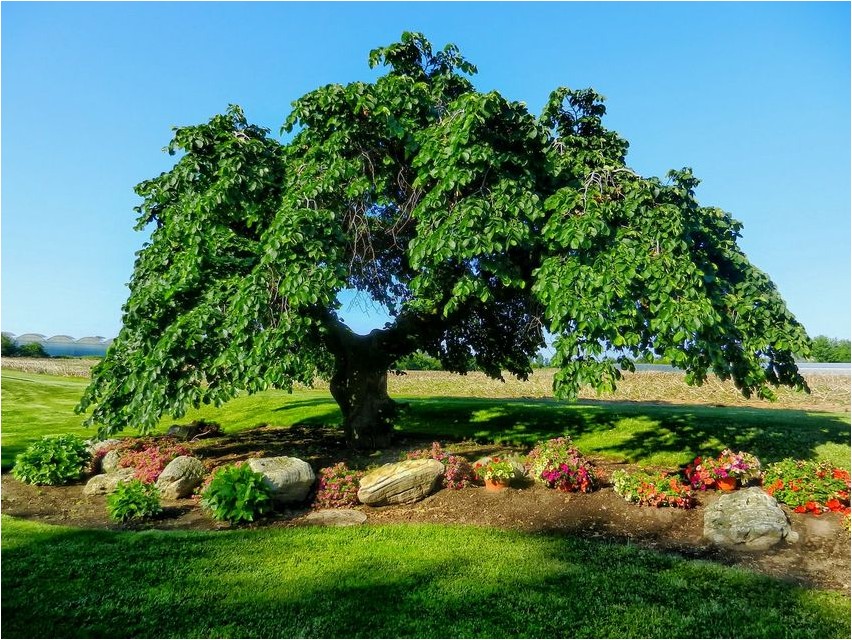
Elm (lat. Ulmus) is a large genus of tall trees belonging to the Elm family (lat. Ulmaceae). They first learned about elm more than 40 million years ago.
In nature, representatives of the genus grow in the Caucasus (Armenia, Georgia, Azerbaijan, etc.), in Central Asia, North America, some European countries and, of course, in Russia, namely in the Southern Urals and the Volga region. Typical habitats are deciduous forests, spruce forests, and areas with fertile soils. Other names: elm, birch bark.
Characteristics of culture
Elm is represented by deciduous trees reaching a height of 40 m. Also in cultivation there are representatives of the genus that grow in the form of large shrubs with a spreading crown of a spherical or cylindrical shape. The branches of the crop in question are smooth. Young shoots are thin. The bark, in turn, is quite strong, brown, very smooth at a young age, later rough, equipped with grooves and cracks.
The root system of elms is classified as powerful. The roots are large, branched, and penetrate deep into the soil. The foliage is alternate, two-rowed, entire, sometimes unequal, often toothed, double-toothed or triple-toothed, of different sizes, sits on short petioles, and has lanceolate, cascading stipules. In autumn, the foliage turns yellow or brown. The flowers of representatives of the Elm genus are very small, unremarkable, collected in bunches, which, in turn, are formed in the axils of the foliage. They are characterized by a bell-shaped, five-parted perianth. Flowering is short, lasting until the leaves appear. Some species are distinguished by autumn flowering.
The fruit of the crop is represented by flattened winged nuts. The seed does not contain endosperm and is similar in appearance to lentils. Fruit ripening is observed in late spring — early summer, which completely depends on climatic conditions, for example, in Caucasian countries, fruits ripen in May. Fruiting is abundant, annual, up to 30 kg of seeds can be obtained from one tree. By the way, the average lifespan of one tree is 100-120 years, although in nature there are specimens that have exceeded the 400-year mark.
Features of cultivation
All members of the genus reproduce both vegetatively and by seed. The latter involves sowing immediately after collecting the seeds, as germination rates decline significantly after a few days. It is recommended to sow the seeds 20-25 cm apart, spacing them lightly; plant them to a maximum depth of 5-7 mm. The following year, the grown plants are transplanted to their permanent location. Elms should be planted in areas with fertile, loose, alkaline, and fresh soil. In saline, dry, waterlogged, marshy, and infertile soils, elms experience poor growth, develop slowly, are frequently attacked by pests and diseases, and often die.

During the first few years, plants require careful and regular care. Particular attention should be paid to a procedure called watering. Watering is recommended as the soil dries out. Spraying is also recommended, preferably in the evening hours closer to sunset. If watering is omitted or done too infrequently, the foliage will turn yellow and begin to fall. Fertilizing is equally important for this crop. It should be applied starting in early spring and then monthly. Both organic and complex mineral fertilizers are necessary. The latter can be purchased at garden markets or specialty stores.
Application
Elms are used primarily for landscaping private gardens, as well as large city parks and gardens. They are often planted on city streets and roadsides. Some species are suitable for pruning, creating unusual shapes. The only drawback of this plant is its frequent pest infestation, so using them in steppe plantings is dangerous. Elm bark is used to produce household dyes, and the wood is used for furniture and supports.