Cornoglav ovate
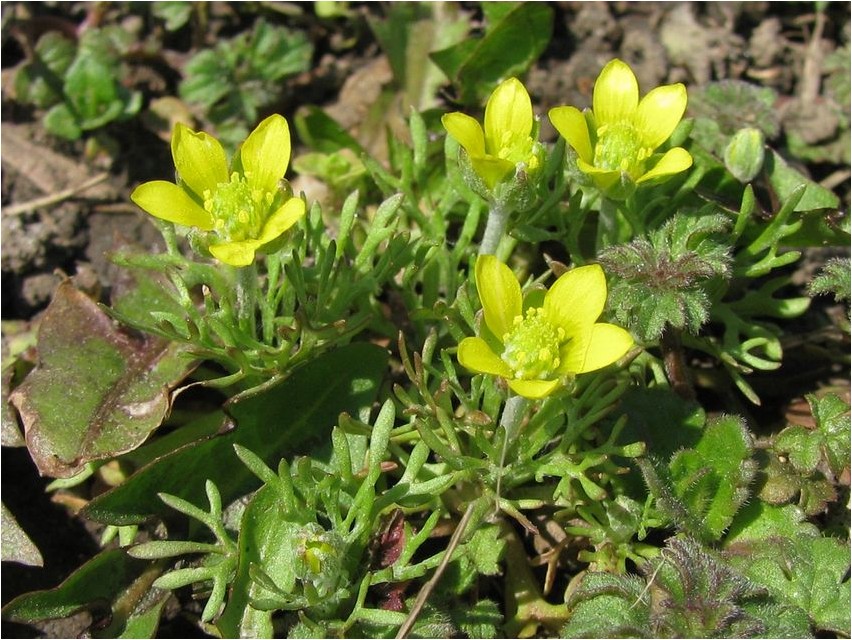
Horncap testiculata is one of the plants of the family called Ranunculaceae; in Latin, the name of this plant will be as follows: Ceratocephala testiculata (Crantz.) Bess.
As for the name of the family of the cornea ovate itself, in Latin it will be like this: Ranunculaceae Juss.
Description of the cornea ovate
Hornhead ovate is an annual herbaceous plant, the height of which will fluctuate between three and ten centimeters. Such a plant can be either almost felt-haired or densely white-haired. The leaves of the cornea ovate are, in turn, palmate-tripartite into two-three-lobed or entire lobes. The peduncles of this plant can either be slightly longer than the leaves or be equal in length to them. Such flower stalks are terminal and lateral, and they will emerge from the very axils of the leaves. The receptacle of the cornea ovate is long-cylindrical, its fruitlets will be hairy, they are endowed with an almost straight nose, which will be hooked at the end.
Flowering of the cornea ovate occurs during the period from March to May. Under natural conditions, this plant is found in Central Asia, Crimea, the Caucasus, and the Lower Volga region of the European part of Russia. For growth, this plant prefers scree, pebbles, cleared pastures, crops, dry slopes, garbage areas, steppes, clayey or sandy deserts. It is noteworthy that the cornea ovate can grow in groups and for this reason sometimes forms thickets.
In addition, this plant can grow along fields and roads, on dry meadows and rocky and gravelly slopes. It is noteworthy that the horn head ovate will predominantly grow in the steppe and forest-steppe zones. It should be noted that animals will not eat this plant, however, animals on pastures can be poisoned for the reason that small animals cannot distinguish cornea ovate from other useful plants. It should be noted that this plant is not only poisonous, but also a weed, for this reason it is important to be careful when handling horncap testicularis.
Description of the medicinal properties of cornea ovatiformis
Cornoglav testicularis is endowed with very valuable healing properties, and it is recommended to use the juice and herb of this plant for medicinal purposes. The term grass includes stems, flowers and leaves.

The presence of such valuable healing properties is recommended to be explained by the content of carotenes, uranium acids, flavonoids, cardenolides, resins and gamma-anemonin in this plant. It should be noted that the horncap is a very poisonous plant, for this reason strict care should be taken when handling this plant. The juice or crushed herb of this plant is recommended for use for eczema and various skin diseases, and also for use as a distraction.
The cornea testicularis will be endowed with very effective bactericidal properties. Preparations prepared from the crushed dry mass of this plant or pure anemone, including an oil solution and ointment, are indicated for use in the practice of both surgical and dermatovenereal clinics. It should be noted that the effectiveness of using such medicinal products in this capacity has been proven experimentally.
It is also important to remember the fact that fresh above-ground mass of cornea testicularis, which is applied to open areas of the body, will have the ability to lead to dermatitis.