Clematis wholeleaf
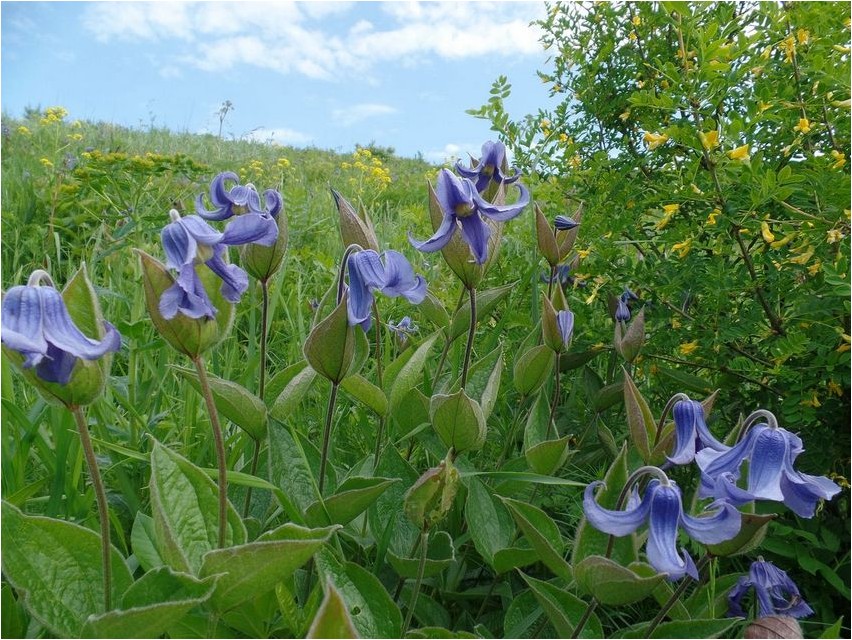
Clematis whole-leaved is one of the plants of the family called Ranunculaceae; in Latin the name of this plant will be as follows: Clematis integrifolia L.
As for the name of the whole-leaved clematis family itself, in Latin it will be: Ranunculaceae Juss.
Description of clematis allifolia
Clematis allifolia is a subshrub, the height of which will fluctuate between fifty and ninety centimeters. Such a plant will be endowed with straight and usually simple stems that are white pubescent and colored in brownish tones. The leaves of clematis allifolia are entire, sessile and oblong-ovate or lanceolate in shape, and the length of such leaves is seven centimeters, in addition, such leaves are also endowed with sharply protruding veins. The flowers of this plant will mostly be single, they are on more or less drooping pedicels. The leaves of clematis allifolia are purple or dark blue in color, they will be pubescent and lanceolate outward, they are usually bent outward, and the length is four to six centimeters.
Clematis allifolia blooms throughout the entire summer period. Under natural conditions, this plant is found on the territory of the European part of Russia in the Lower Don, Black Sea, Zavolzhsky and Volga-Don regions, in the south of Belarus, in the Crimea, in Central Asia, in the Carpathians and in the Dnieper region of Ukraine, as well as in the south-east of the Irtysh region of Western Siberia and in the west of the Altai region. For growth, this plant prefers meadows and clearings, forest edges, steppes, thickets of bushes, rocky slopes and mountain river valleys at an altitude of up to three thousand meters above sea level.
Description of the medicinal properties of clematis wholeleaf
Clematis wholeleaf is endowed with very valuable healing properties, and it is recommended to use the herb of this plant for medicinal purposes. The term grass includes leaves, flowers and stems.
The presence of such valuable healing properties should be explained by the content of resins, alkaloids, tannins, vitamin C, ranunculin, steroid saponins and gamma-lactone in this plant. The fruits of this plant contain fatty oil. A decoction and infusion prepared from the herb clematis wholeleaf is endowed with very effective fungicidal, anticonvulsant, bactericidal, raticidal and protisticidal effects. As for the external use of such a healing agent, an infusion of the leaves of this plant is used for fungal and purulent skin diseases. In addition, an infusion prepared from the leaves of clematis allifolia is recommended for use for rheumatism, ascites, syphilis and various stomach pains.

It should be noted that clematis allifolia is a poisonous plant, for this reason it is recommended to exercise extreme caution when handling this plant.
For all of the above diseases, the following remedy based on whole-leaved clematis is quite effective: to prepare such a healing remedy, you will need to take one tablespoon of crushed leaves of this plant per two glasses of boiling water. It is recommended to infuse the resulting medicinal mixture for about two hours, after which it is recommended to strain this medicinal mixture based on this plant very carefully. Take the resulting healing remedy based on whole-leaved clematis three times a day before meals, one tablespoon. It should be noted that this healing remedy is very effective when taken correctly.





