Liquidambar
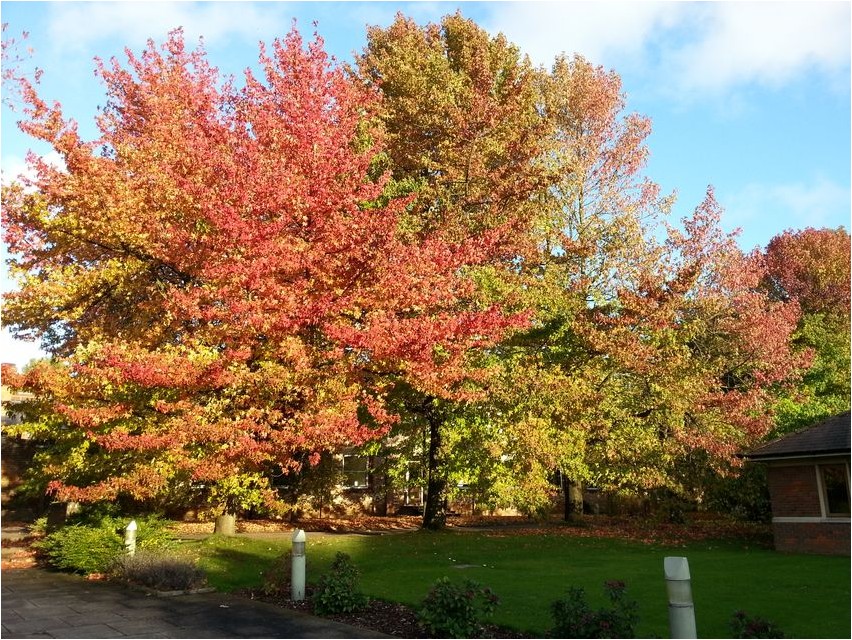
Liquidambar (lat. Liquidambar) is a genus of large deciduous trees of the Altingiaceae family. Previously, the genus was classified as a member of the Witch Hazel family.
The genus includes five species. Liquidambar is found naturally in North America, Asia and Europe.
Characteristics of culture
Liquidambar is a deciduous tree 25-40 m high. The leaves are palmate-lobed, spirally arranged along the stem. The flowers are monoecious, quite small, collected in dense spherical inflorescences up to 2 cm in diameter. The inflorescences hang on the petiole. The fruit is a spherical woody capsule, up to 4 cm in diameter, containing a large number of seeds. The fruits remain on the branches even after the leaves fall. The crop cannot boast of frost-resistant properties; for this reason, in Russia it is grown only in the southern regions.
Growing conditions
Liquidambar has a taproot system with branched and fleshy roots, sensitive to compacted soils. Plants develop best on acidic loamy and clayey soils, and waterlogging does not affect representatives of the genus in any way.
Liquidambaras are also tolerant of highly saline soils. The location is preferably sunny; lack of light can lead to rotting, especially on waterlogged soils. The culture has a negative attitude towards excess lime and dry soil. On alkaline soils, plants are often affected by various diseases, in particular leaf chlorosis.
Reproduction and planting
Liquidambar is propagated by seeds and cuttings. Sowing of seeds is carried out in the fall under cover or in the spring with a preliminary two-month stratification. Most of the seeds germinate without pre-sowing treatment, but the entrances appear unfriendly and weak. The seed placement depth is at least 1. 5-2 cm.

With the emergence of seedlings, young plants are planted in separate containers and grown indoors for about 3-4 years. Then the strengthened and formed plants are transplanted into open ground. Planting liquidambar seedlings is popular among gardeners; they must be purchased only in specialized centers. Planting is carried out in the fall; the soil in the tree trunk zone is necessarily mulched with peat or humus.
Care
Liquidambars are quite often affected by pests and diseases, and in order to prevent these unpleasant consequences, it is necessary to carefully care for the plants. Regular watering is recommended, because the crop does not tolerate drought. Liquidambar also needs sanitary pruning, which involves removing dry, randomly located and damaged shoots.
Feeding is also regular, at least once a year. For these purposes, both organic and mineral fertilizers are suitable. It is important to combat diseases, especially fungal infections that lead to leaf deformation and the appearance of reddish or orange pads on the branches.
Application
Liquidambar is used in single and group plantings; plants are especially valued in autonalia (autumn flower gardens), since in the autumn they are highly decorative due to the beautiful color of the leaves. The resin released by trees when the bark is damaged is used as an antiseptic for inhalation, as well as in soap making and perfumery. Once upon a time, resin was also used to flavor tobacco products; in some southern states of the United States, this tradition has been preserved to this day.





