Moss clubmoss
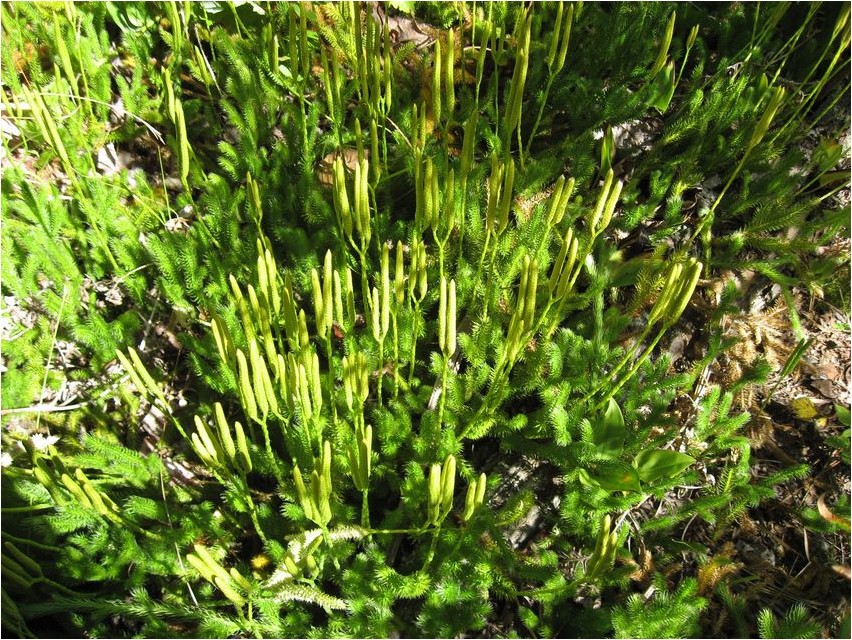
The club moss is one of the plants of the family called Mocopoaceae; in Latin the name of this plant will be as follows: Lycopodium clavatum L.
As for the name of the club moss family itself, in Latin it will be: Lycopodiaceae.
Description of the clubmoss
The clubmoss is known under numerous popular names: dryaba, dzaroga, floater, snake moss, kolutnika, laxative, creeper, trampling and tsakun. Moss clubmoss is a perennial evergreen herbaceous plant. The stem of such a plant is creeping, its length will be about one to one and a half meters, such a stem is rooting and it will be branched, endowed with ascending forked branches. Such branches will be covered with narrow-linear lanceolate leaves that do not fall off in the winter and end with a long white hair.
Sporulation of this plant occurs during the period from July to August. Under natural conditions, this plant is found in the Caucasus, the Far East, coniferous forests of the European part of Russia, Western and Eastern Siberia. As for the general distribution, this plant is found in Japan, the Arctic, Mongolia, Scandinavia, North America and China.
Description of the medicinal properties of club moss
The club moss is endowed with very valuable healing properties, and it is recommended to use the entire aerial part and spores of this plant for medicinal purposes.
The presence of such valuable healing properties is recommended to be explained by the content of fatty oil, protein, sugar, protein, glycerin, polymer terpene sporatin, minerals and cholesterol in this plant. It is noteworthy that the aerial part of this plant will contain dioxystearic acids, the flavonoid apigenin and the following alkaloids: tanacenic acid, nicotine, clavatine, clavotoxin and lycopodia.

The spores of the club moss will be endowed with very valuable anti-inflammatory, diuretic, choleretic, anticonvulsant and hemostatic effects.
In folk medicine, this plant is quite widespread. An infusion prepared from the spores or herb of the clubmoss is recommended as an analgesic, anti-inflammatory, antispasmodic, and emollient. Furthermore, such remedies are indicated for gastritis, various liver diseases, bronchitis, laryngotracheitis, spasms, colic, cystitis, enterocolitis, kidney and bladder stones, and gastrointestinal pain. Externally, an infusion of this plant’s spores is used for douches, baths, and compresses for a variety of skin conditions: itchy rashes, ringworm, scabies, wounds, bruises, boils, and skin lesions. The dry powder of this plant is used to dust diaper rashes and burns. For rheumatic pain, colic, and kidney and digestive disorders, the herb of this plant is recommended as a very effective sedative. For stomach cramps, the following remedy is recommended: to prepare this remedy, take seven teaspoons of crushed clubmoss sprigs and add two cups of boiling water. This is the daily dose for this herbal remedy. This remedy based on clubmoss is very effective, and the positive effects will be noticeable quite quickly.
Clubmoss (Clubmoss)





