Maynik two-leaf
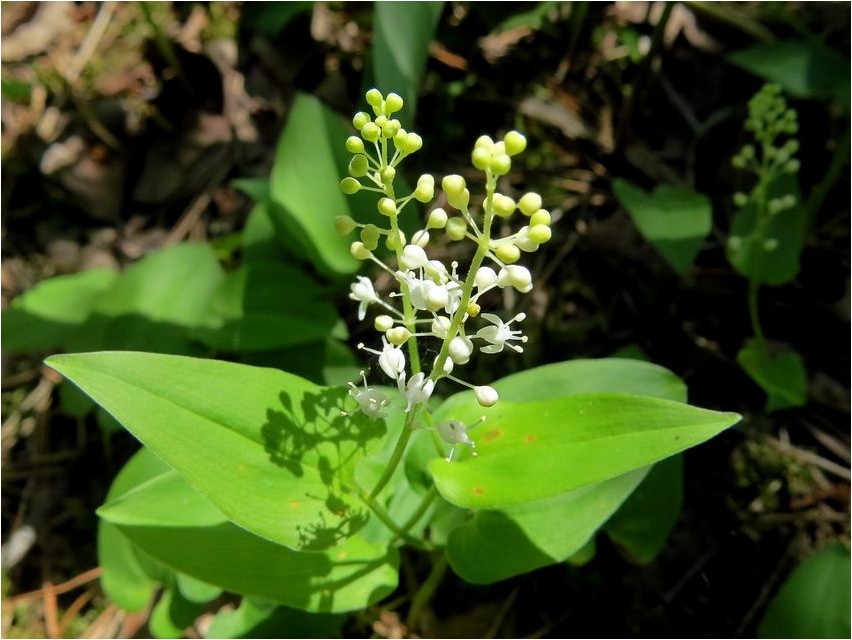
The bifoliate plant is one of the plants of the family called Liliaceae; in Latin the name of this plant will be as follows: Mojanthenum bifolium (L.) F. W. Schmidt.
As for the name of the bifoliate plant itself, in Latin it will be like this: Liliaceae Juss.
Description of the two-leaf mine
Mynik bifolia is a perennial herbaceous plant endowed with a thick horizontal long rhizome. The height of the stem of this plant will be about ten to fifteen centimeters, such a stem is erect and longitudinally ribbed, at the very base this stem will be covered with membranous sheaths. The leaves, two or three in number, are alternate and close together, they can be either heart-shaped or deeply heart-shaped-ovate, they are sharp and petiolate, they are equipped with a notch at the base and are even entire. The flowers of this plant are painted white, they are endowed with a very delicate scent, and can be either single or in quantities of two or three. Such leaves of Mynika bifolia are found in a sparse apical oblong-ovate raceme, and are also found on rather long pedicels. The fruit of this plant is a spherical berry, which is initially yellow with dark red specks, and when ripe the berry will be purple-pink in color.
Flowering of two-leaved myna occurs in the month of June. Under natural conditions, this plant is found in the European part of Russia, Ukraine, the Far East, Siberia and Belarus. For growth, this plant prefers dry sandy soils, places between bushes, coniferous and coniferous-deciduous forests, and sometimes deciduous forests. It is noteworthy that this plant is also an early honey plant.
Description of the medicinal properties of mynika bifolia
Maynik bifolia is endowed with very valuable healing properties, and it is recommended to use the herb of this plant for medicinal purposes. The concept of grass includes the leaves, stems and flowers of this plant. It is recommended to harvest such raw materials throughout the entire flowering period of this plant.
The presence of such valuable healing properties should be explained by the content of saponins, glycosides and coumarins in the composition of this plant, while vitamin C will be present in the leaves of the plant.

In folk medicine, remedies based on May lily are quite common. A decoction made from May lily is recommended for kidney and heart ailments, as well as various colds accompanied by a high fever. Poultices made from this plant are used for various tumors. A weak infusion of May lily is recommended for childhood constipation and various gastrointestinal ailments, and externally, this infusion is used for conjunctivitis. A tincture made from this plant in 40% alcohol is recommended for use as a very effective antipyretic, taking twenty to twenty-five drops.
It’s worth noting that May lily is also used to prepare various soft drinks and complex teas. The red berries of this plant produce a reddish-blue dye. For colds, use a decoction of one tablespoon of crushed dried Mayflower per cup of boiling water. Take this remedy three times a day, one-third of a cup at a time.
Mayanika Bifolia 600 Medicinal Plants





