Plantain lanceolifolia
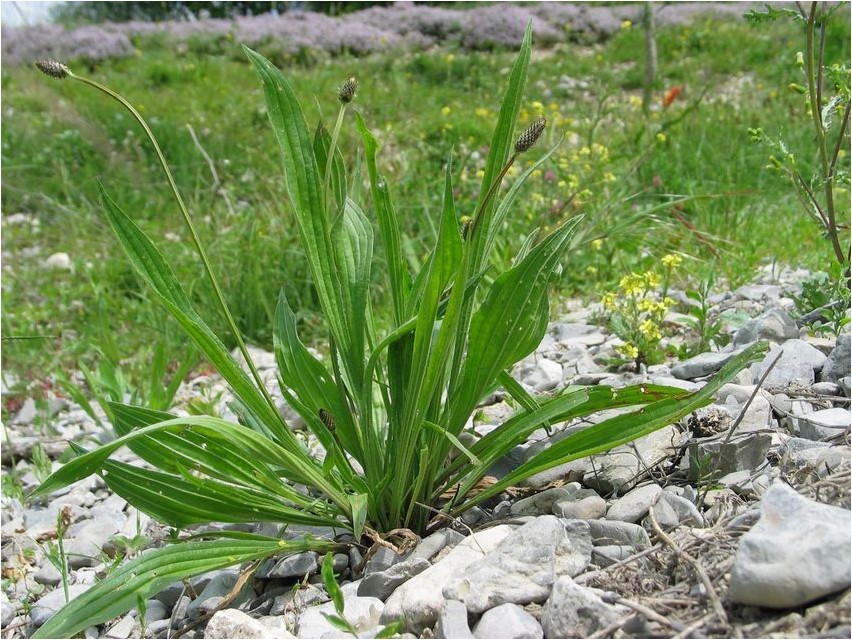
The lanceolate plantain is one of the plants of the family called plantains; in Latin the name of this plant will be as follows: Plantago lanceolata L.
As for the name of the lanceolate plantain family itself, in Latin it will be: Plantaginaceae Juss.
Description of lanceolate plantain
Lanceolate plantain is known by numerous popular names: prisoner, goats, road worker, tongues grass, mare stets, arzhenik, Volska grass, rannik, dog tongues and screed. Lanceolate plantain is a perennial herbaceous plant with a tap root and a short oblique rhizome. The leaves of this plant are lanceolate and linear-lanceolate, they will be collected in a basal rosette, there are often several flower shoots and they will be straight or ascending, as well as leafless. The height of such flower arrows will be approximately eight to twenty centimeters, and they will be sparsely grooved along the entire length. The calyx of plantain lanceolate is trilobed due to the fusion of the two anterior lobes into wide scales. The capsule of this plant is elliptical and two-seeded, and its length will be about three millimeters. The seeds of plantain lanceolate will be oblong or oblong-elliptical, while on one side they are convex, and on the other they will be grooved and endowed with a dark scar.
Flowering of lanceolate plantain occurs in the period from June to July. In this case, the ripening of the seeds of this plant will occur three weeks after fertilization. Under natural conditions, lanceolate plantain is found in Central Asia, the European part of Russia, the Far East, Ukraine, Belarus and Western Siberia. For growth, this plant prefers fallow lands, places near roads, dry meadows, wastelands, grassy open slopes and river banks.
Description of the medicinal properties of plantain
Lanceolate plantain is endowed with very valuable healing properties, and it is recommended to use the seeds, roots and leaves of this plant for medicinal purposes. The presence of such valuable healing properties is recommended to be explained by the content of linoleic acid and the following steroids in the roots of this plant: cholesterol, campesterol, sitosterol and stigmasterol. The aerial part of this plant will contain aucubin, the acyclic compound loliolide, flavonoids, phenolcarboxylic acids and their derivative rhamnosyl glucoside caffeic acid. The leaves, in turn, contain carbohydrates, mannitol, phenolcarboxylic acids and their derivatives, fumaric acids and iridoids. The seeds of plantain lanceolate contain fatty oil, carbohydrates and related compounds.
A decoction prepared from the roots of plantain is recommended for use in various stomach diseases, cystitis, headaches, pulmonary tuberculosis, and is also used as a diuretic and detoxifying agent for snake bites.

Infusion, juice and decoction of the leaves of this plant are endowed with very effective anti-inflammatory, bacteriostatic, antispasmodic, expectorant and wound-healing effects. Such healing agents are used for pulmonary tuberculosis, malaria, bronchitis, acute respiratory diseases, anemia, scrofulosis, allergies, enterocolitis, gastric ulcers and various liver diseases. Externally, such healing agents are indicated for use in ulcers, swelling, furunculosis and purulent wounds. The powder of this plant is used in turn for anthrax.





