Hydrangea
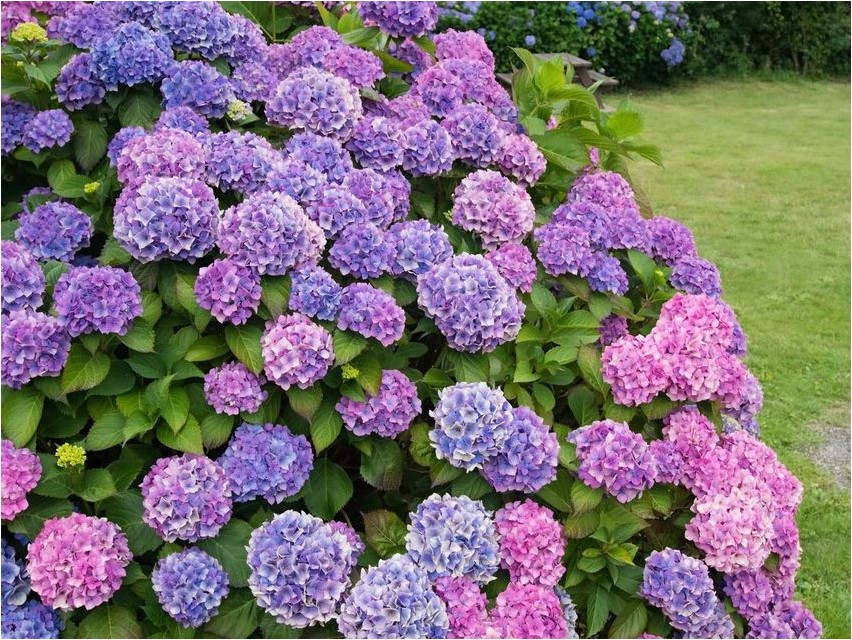
Hydrangea (lat. Hydrangea) is a beautiful flowering ornamental shrub or tree of the Hydrangeaceae family. Under natural conditions, hydrangea grows in North and South America and East Asia.
Two types of plants are found in Russia. Currently there are about 80 species.
Characteristics of culture
Hydrangea is a deciduous or evergreen shrub, less often a tree or liana, 1-3 m high. The leaves are dense, green, sometimes shiny, most often elliptical or ovoid in shape, located oppositely. The flowers are numerous, collected in large corymbose or conical panicles, and can be white, cream, blue, red, lilac or pink. Flowers on hydrangeas are usually of two types: at the edges — large and showy, in the middle — small and fruit-bearing. The fruit is a 2-5 divided capsule. The seeds are small.
Growing conditions
Hydrangea is a rather demanding plant when it comes to growing conditions. The culture prefers semi-shaded areas and has a negative attitude towards direct sunlight (except for Hydrangea macrophylla and Hydrangea paniculata, these species also develop well in sunny areas). The soils for growing hydrangeas are preferably moist, loose, fertile with an acidic pH.

Does not tolerate calcareous soils and areas with close groundwater. Alkaline soils are not suitable for growing crops and require preliminary acidification. Most varieties of hydrangeas are highly frost-resistant, but unripe shoots freeze during severe frosts.
Reproduction and planting
Hydrangea is propagated by seeds, cuttings, dividing the bush, layering and grafting. The most effective and simplest method of propagation is cuttings. The more labor-intensive method is the seed method. Sowing is carried out in March-May in seedling boxes filled with a substrate consisting of leaf soil, peat, humus and sand (2: 1: 2: 1). Seeds do not need preliminary stratification. The crops are regularly watered using a spray bottle. Shoots appear after about 30 days. Seedlings are periodically fed with liquid complex fertilizers. The seedlings are planted in open ground until 2-3 true leaves appear on the seedlings. Young plants are covered for the winter.
The best time for successful rooting of crop cuttings is the flowering period, that is, mid-July. Cuttings are cut from one-year-old side shoots. Too thick and strong shoots from hardwood are not suitable. The cuttings are rooted in a light, moisture-intensive substrate consisting of high-moor peat and coarse sand (2:1). Sphagnum moss is often added to the substrate, this is necessary to increase moisture capacity. Before planting, cuttings are treated with growth stimulants. The cuttings are buried 2-3 cm into the substrate. The distance between the cuttings should be at least 3-5 cm. The cuttings take root in 3-4 weeks. Young plants are planted in a permanent place after 1. 5-2 years.
Care
Hydrangea is moisture-loving and requires systematic and abundant watering (at the rate of 15-20 liters per bush). To retain moisture and acidify the soil near the tree trunk, it is mulched with wood chips, bark, leaves or pine needles. Plants have a negative attitude towards compacted soil, therefore it requires regular loosening to a depth of 5-6 cm. Hydrangea responds positively to fertilizing with mineral and organic fertilizers.
Pruning is carried out only by paniculate hydrangea and petiolate hydrangea. It is impossible to prune large-leaved hydrangea, since the buds form on last year”s shoots. In the above species, inflorescences form on new shoots. Pruning is done in March-April, but before the buds swell. Late timing of this procedure can have an extremely negative impact on the plant; they may not bloom and will develop poorly. Shrubs that are too old need strong rejuvenating pruning.
For the winter, hydrangea requires shelter, especially for heat-loving species. A few days before the onset of stable frosts, the bushes are hilled up, mulched with dry peat and covered with lutrasil or plastic film (in two layers).
Application
Hydrangea is a highly decorative flowering shrub that will always take its rightful place in gardens and summer cottages. The culture is used both in single and group plantings. Hydrangeas look great in tapeworms, as well as in hedges. Low-growing forms go well with roses, irises and clematis. Some types of hydrangeas are used in vertical gardening to decorate the walls of houses, outbuildings and other buildings.