Mytnik swamp
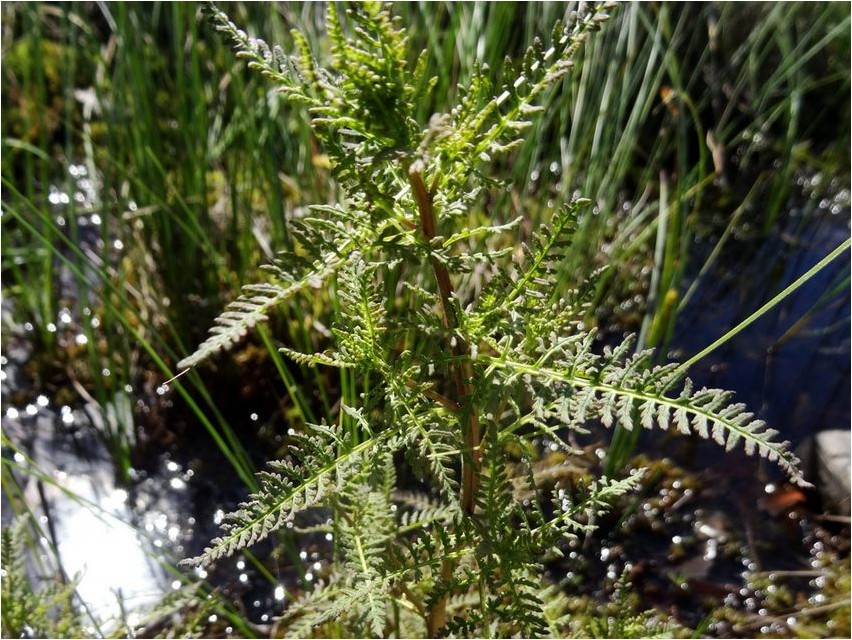
Marsh mytnik is one of the plants of the family called Noricaceae; in Latin the name of this plant will be as follows: Pedicularis palustris L.
As for the name of the marsh grass family itself, in Latin it will be: Scrophulariaceae Juss.
Description of the marsh mytnik
Swamp mytnik is also known under numerous popular names: lice grass, lousy grass, rotting grass, Irva grass, forest vitriol, ragulnik, nasadnik and clergyman. Marsh mytnik is a biennial herbaceous plant, endowed with a low, faceted, splayed, branched stem, which can be either bare or hairy, and the height of such a stem will fluctuate between fifteen and fifty centimeters. The basal leaves of this plant will form a rosette. The stem leaves of the marsh grass are either almost opposite or alternate, they will be linear-lanceolate and sessile, their length will be about two to three centimeters. Such leaves are pinnately dissected and will be endowed with cartilaginous crenate-lobed segments, which will be so along the edge. The flowers of the marsh grass are painted in purple or pink tones, they are five-membered and two-lipped, there are only four stamens of this plant, they are located in the axils of the bracts and will form inflorescences at the very ends, which will be very loose in the lower part. The fruit of this plant is an obliquely ovoid capsule, which opens from the back, and is also endowed with a short spout.
The flowering of the marsh myrtle occurs in the period from June to August. Under natural conditions, this plant is found in Polesie, Ukraine, the North Caucasus and the European part of Russia. For growth, this plant prefers the banks of reservoirs, swampy meadows, grass and moss swamps, ranging from the tundra zone to the forest-steppe. It is noteworthy that the swamp grass is not only an insecticide, but will also be a very poisonous plant.
Description of the medicinal properties of the marsh myrtle
Marsh mytnik is endowed with very valuable healing properties, and it is recommended to use the herb of this plant for medicinal purposes. The term grass includes stems, flowers and leaves. It is recommended to harvest such raw materials throughout the entire flowering period of this plant. The presence of such valuable healing properties should be explained by the content of the glycoside aucubin in this plant, which is known as rhinanthin. Upon hydrolysis, such a substance will break down into glucose and amorphous aucubigenin. Also, a small amount of aucubin will be contained in the seeds of the marsh grass, while the grass contains traces of alkaloids.
Mytnik marsh is endowed with very effective wound-healing, anti-inflammatory, hemostatic and diuretic effects. It is noteworthy that the experiment proved that an infusion based on this plant will affect the uterus in the same way as ergot, but this effect will be somewhat weaker.

As for traditional medicine, healing remedies based on this plant are quite widespread. A decoction and infusion based on mytaria is indicated for oral use during uterine bleeding as a hemostatic agent, and also as a diuretic. In addition, such a healing remedy based on this plant is quite acceptable and can be used externally to accelerate the healing of various wounds. Infusion and decoction of this plant is used as an antiparasitic agent in the fight against lice.





